


$5,900 awarded to Alberta amateur golf athletes

This year, Alberta Golf was able to award a combined total of $5,900 of Athlete Assistance to 21 deserving golfers. Funding was given to those who will attempt to make their mark this season and compete in regional, provincial, national and international events.
Multiple-year award winner, Matt Williams, says that “funding from Alberta Golf has allowed me the opportunity to compete in Canada’s national championships in year’s past. My primary golf goal is to play my way onto the Canadian Men’s National Team. This goal has me really focused and working harder and smarter than I ever have before.”

Matt Williams in 2014 as a Team Canada athlete.
The Team Alberta High Performance Squad member is a shining example of the self-driven enthusiasm and hard work that so many of this year’s award winners demonstrate across the province.
“A couple years ago I really struggled with golf and wasn’t sure if it was something I would want to pursue long-term, but since then I feel I have rebounded, and I certainly have a whole new appreciation for golf when I am playing well. It’s nice when golf is fun. My dad always wanted me to be a hockey player when I was younger, and while I took it pretty seriously for a while, golf eventually took over.”
Not only does he continue to raise the bar for himself on the course, but he is also a full-time student. As a University of Houston teammate, he must balance the day-to-day challenges of being a competitive amateur golfer, while completing an accounting degree. His hard work is paying off. Williams was a part of Golf Canada’s National Development squad for two years, and he is currently Alberta’s top ranked player in the World Amateur Golf Rankings.
We can’t wait to see what’s next for all of this year’s recipients, and we will be cheering them on! Congratulations to the following 2017 Athlete Assistance recipients:
- Matt Williams
- Brendan MacDougall
- Ethan Choi
- Evan Holmes
- Kenna Hughes
- Max Murchison
- Lauren Diederichs
- Jack Wood
- Andrew Harrison
- Sang Won Kim
- Susan Thomson
- Joan Wilson
- Owen Murray
- Jeff Murdoch
- Ethan Palmer
- Cody Adolph
- MacKenzie Baustad
- Mandy Wong
- Alex Large
- Ryan Hounjet
- Mitchell Fleming
To learn more about the Alberta Golf Athlete Assistance program, click here.
Real golfers keep handicaps

You’ve heard the boilerplate reasons to maintain an accurate handicap factor.
“Level playing field.” “Track your progress.”
Blah, blah, blah.
Here’s the real reason.
Don’t be a cheater. Be a real golfer. An honest golfer.
Oh, I am sure your intentions are good. You stand on the first tee and when asked what your handicap factor is, you say, “Well, I usually shoot about xx.” Then you go and shoot xx minus 10.
There’s no polite way to say this. You cheated. And you are no doubt a little embarrassed. As an unintentional result, there will be whispers of “sandbagger” when your name is mentioned subsequently.
I have no doubt your intentions were honourable and so are you. But because you didn’t have a verifiable factor, you cheated your fellow competitors (who hopefully had a Golf Canada handicap factor) of the opportunity to compete equitably.
If anyone has a passion for this topic, it’s Craig Loughry, Golf Canada’s Director of Handicap and Course Rating. Only he would call the handicapping system “cool.”
“The obvious cool part of handicaps is allowing golfers of any ability to have either a fun, friendly match with a friend or relative or a serious competition with anyone. Look at the alternative. Otherwise, the higher-handicapped player would be slaughtered in a gross stroke-play event or worse, they enter into a heated negotiation on the first tee as to how many strokes each should get.”
Loughry points out that the Golf Canada handicap system provides for golfers who play from different tees in the same event to compete on an equitable basis.
And there are many other advantages to maintaining an accurate and official Golf Canada handicap factor over other informal and unapproved score tracking systems, including being able to observe your progress (or lack thereof) over the course of years.
Consider yourself a “real golfer”?
You’re not if you don’t maintain an accurate Golf Canada handicap factor.
And if we meet on the first tee, you’re not getting any strokes from me.

Golf Canada and the PGA of Canada publish Golf Facilities in Canada 2017 report

Golf Canada, in partnership with the PGA of Canada, has released Golf Facilities in Canada 2017—the definitive report on golf facilities and development in Canada.
Golf Facilities in Canada 2017 is a collaborative effort between Golf Canada, the PGA of Canada and the National Golf Foundation (NGF), a golf industry knowledge research firm which delivers independent and objective market intelligence, insights and trends.
The report, which is a follow up to the 2015 Golf Facilities in Canada Report, identifies all existing public and private facilities in the country; and defines supply by province, type and number of holes. The report also includes information on facility openings and closings, as well as the number and type of facilities currently in development.
“The 2017 edition of the Golf Facilities in Canada report provides a comprehensive snapshot of the Canadian golf landscape and the abundance of golf experiences in communities from coast to coast,” said Golf Canada Chief Sport Officer and interim CEO Jeff Thompson. “We are proud to partner with the NGF and the PGA of Canada in presenting the second iteration of this in-depth summary of national and provincial golf facility data.”
“The PGA of Canada in partnership with Golf Canada is excited to present this captivating study of golf facilities in Canada compiled by one of the world’s leading research firms, the National Golf Foundation,” said PGA of Canada CEO Gary Bernard. “As the second oldest and third largest professional golf association in the world, the PGA of Canada and its 3,700 members are proud to be a driving force at golf facilities from coast-to-coast.”
A snapshot of data captured in Golf Facilities in Canada 2017:
- Canada is home to 2,298 public and private golf facilities; ranking it second in the world in total supply.
- Seventy-seven per cent of the total golf supply is located in Canada’s four most populated provinces—Ontario, Québec, Alberta and British Columbia.
- Golf remains extremely accessible in Canada with nearly 90 per cent of the country’s supply open to the public.
- Of the 2,068 daily fee or public facilities in Canada, 48 per cent are located in Ontario and Québec, which together account for 61 per cent of the country’s total population. The two provinces are also home to 73 per cent of Canada’s 230 private clubs.
- Nine-hole golf (838 facilities) accounts for more than 36 per cent of Canada’s total supply. In Saskatchewan, 18-hole courses are outnumbered almost three to one (51 vs. 149) by 9-hole courses.
- Canada features nine 12-hole facilities (six of which are in Ontario) and a single 6-hole facility which is located in Manitoba.
- Resort golf, though a small segment of Canada’s overall supply, is a significant contributor to tourism in several provinces. Countrywide, 169 facilities (or approximately seven percent of total supply) are connected to a resort or a resort/real estate operation.
- Since 2010, 26 facilities have opened in seven different provinces including Alberta, which leads the way with eight openings during that period. In recent years, Canada has seen only moderate growth, and currently has 22 18-hole equivalent facilities in various stages of development.
- Since 2015, 51 facilities have been reported as closed, including 19 in Ontario. Canada’s largest province accounts for 37 per cent of total Canadian closures as well as 35 perc ent of Canada’s total supply.
The complete Golf Facilities in Canada 2017 report including national and provincial data is available for download here.
Globally, Canada’s 2,298 facilities represent seven percent of the world’s total supply of golf facilities (33,161). Canada ranks second in total supply behind the United States (15,014) and is ahead of Japan (2,290), England (1,991), Australia (1,591) and Germany (747) among the countries with the next highest total supply. For more on the world report, visit randa.org.
Remembering Sid Puddicombe

Sid Puddicombe with his sons Tod, Mark and Grant at the grand opening of RedTail Landing Golf Club
On June 1, 2017 the Alberta golf industry lost one of its pioneers in Sid Puddicombe. He passed away at the age of 85. Sid would become known as the patriarch of golf course superintendents in Alberta. He got his start watering greens at night in Saskatchewan. His first formal training was provided in Winnipeg by a Canadian turfgrass legend by the name of John B. Steel whose name now adorns the Canadian Golf Course Superintendents Association highest annual award for excellence; an award that Sid proudly won in 1987.
Sid worked at the Saskatoon Riverside Golf Course until 1968. He then moved to the Mayfair Golf and Country Club where he plied his trade until 1988. He was the first to successfully implement covering greens in the winter to enhance spring conditions.
Always one to give back to the game, Sid was well known for mentoring young up and coming superintendents, many of whom became well renowned in their own right. Following along a long line of golf course turf managers, Sid also volunteered his time to the Alberta Golf Association as a director with a role to educating clubs on the tricks of the trade. He started a turf school at the Fairview and Olds Colleges and was instrumental in hosting annual spring conferences with the goal of furthering the conditions of all Alberta golf courses through education.
Sid would later go onto create his own golf course design and construction company. Along with his 3 sons, the Puddicombe’s have influenced the design and construction of a multitude number of courses worldwide.
Sid was inducted into the Alberta Golf Hall of Fame in 2010 under the Distinguished Service Category. See more here.
A Celebration of Sid’s Life will be held Wednesday, June 7 at 3:00 p.m. at RedTail Landing Golf Club Tournament Centre, located at the Edmonton International Airport. – See more
New operating committee structure provides increased industry engagement

Executive Director/CEO Phil Berube and Volunteer Dan McDougall at the 2017 Spring Launch.
Volunteers, industry stakeholders, board members and staff met in Sundre, AB during the 2017 Season Launch. The meeting marked the next step in the evolution of an operating committee structure which will help to provide strong, thoughtful and representative operating recommendations to the Alberta Golf Board of Directors.
The model was designed to both simplify Alberta Golf’s internal processes and further engage all industry stakeholders in the province. The four operating committees that met included: Brand & Business Development, Competitions & Performance, Membership & Golf Course Services, and Recreational & Community Events.
“The four operating committees at Alberta Golf provide all industry stakeholders, including our network of volunteers, with a clear channel in which to provide input into the strategy and future direction of Alberta Golf. It is part of our engagement process”, said Phil Berube, Executive Director/CEO of Alberta Golf.

Each committee is comprised of specialists and experts in their various fields. From club managers and journalists, to executive directors and competitive players, the broad spectrum of knowledge and experience was evident. The operating committees will continuously meet and connect with one another throughout the year to share ideas and formalize plans. Task forces will then be created within in each area to help with identified operational goals and specific projects.
Berube added that “as these committees continue to meet and deliberate over specific issues in the coming years, our decision making process will clearly reflect the opinions and expectations of all golfers in our province, providing our Board of Directors with strong recommendations for consideration.”
The model was introduced to give those at the table an opportunity to be fully engaged and to directly impact the business of Alberta Golf. The committee structure will support the associations business plan and related tactics. Berube said “from a staffing standpoint, I am looking forward to announcing very soon how our structure and roles will support these committees.”
Blake and Swelin receive Hall of Fame recognition
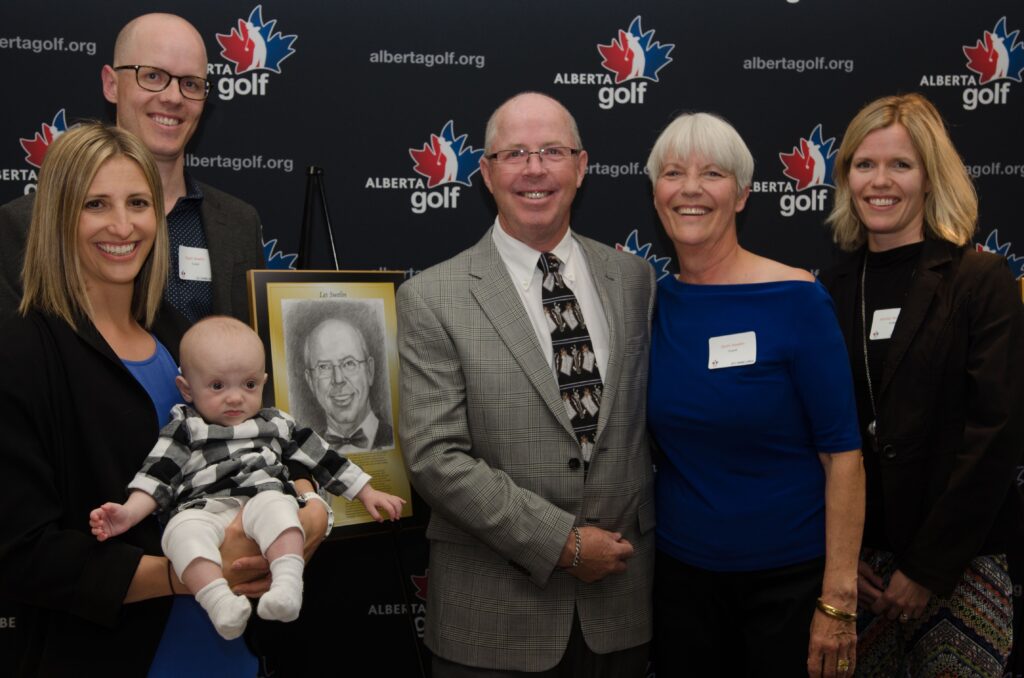
Les Swelin – 2017 Alberta Golf Hall of Fame inductee with his family
Anna Sewell said, “It’s good people who make good places.” Martin Blake and Les Swelin made that clear as they were recognized as pillars in the Alberta Golf community. With their trademark modesty, they both accepted their Hall of Fame awards amongst a gathering of friends, family and industry partners last night at the 2017 Season Launch in Sundre, AB.
Both Blake and Swelin were emotional thanking and recognizing all the people in their lives that supported them up to that moment. A long pause of warmth and kindness were felt as Blake spoke of his wife Norma. While Swelin’s memories within the organization had the whole room chuckling with both highlights and humorous lowlights of times past.
Sandra Craig, a past Alberta Golf president, spoke of Blake’s charisma and how he demonstrated all of the key competencies of a great volunteer, leader and rules official. Dunc Mills, long-term volunteer and friend of Swelin, told the story of a man who was so determined and involved within the game that he had once set out to build his own putting green at his home club.
These two inductees have helped, and continue to help, shape the organization. An entire new generation of volunteers have been impacted by their mentorship and leadership. Last night was a well-deserved celebration of their accomplishments and the people they’ve impacted throughout their lives. Thank you from all of us within the Alberta Golf community.
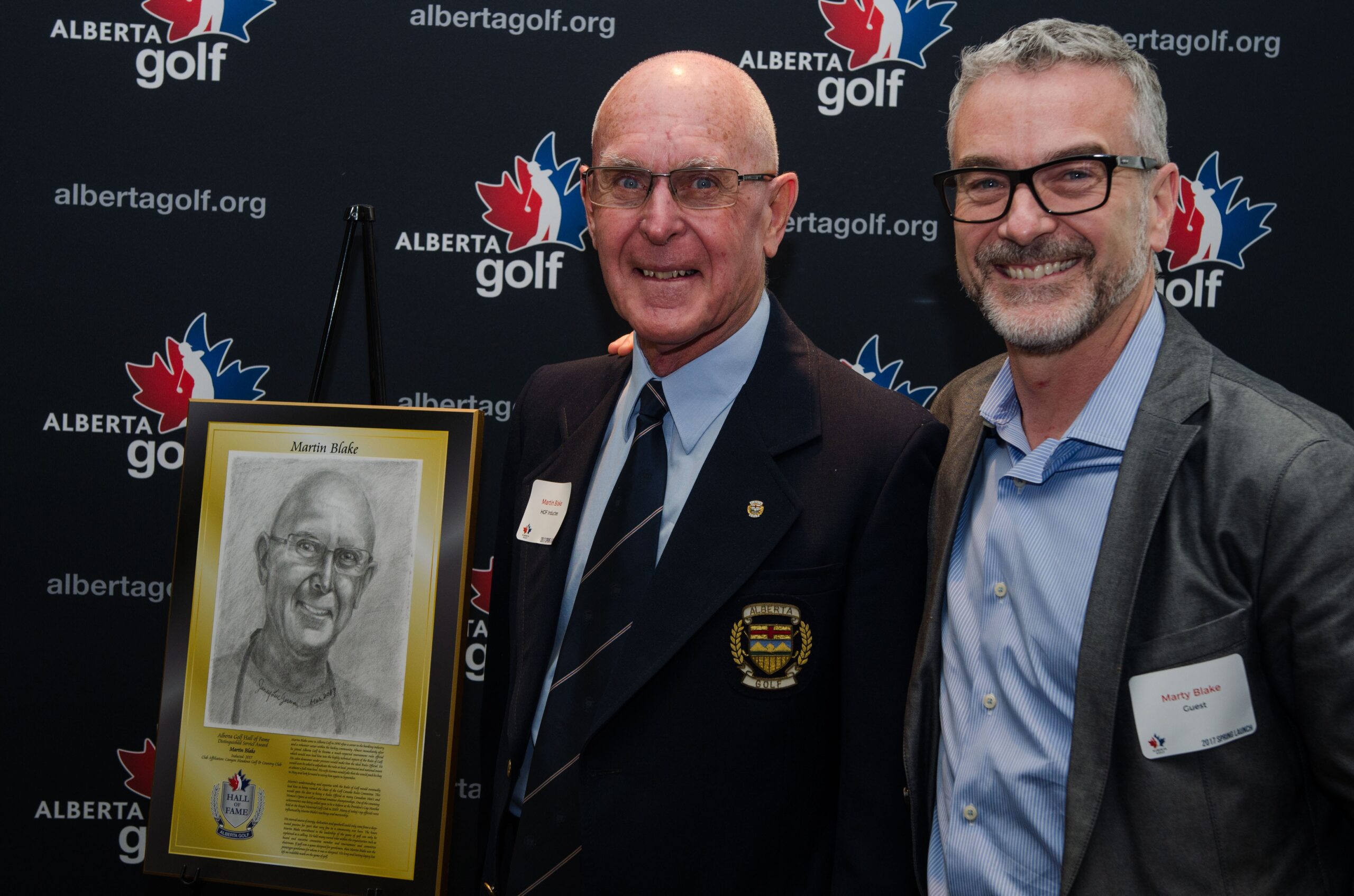
Martin Blake with his son Marty Blake
Golf Canada appoints Laurence Applebaum as new CEO

Following a comprehensive search, Golf Canada has announced the appointment of Laurence Applebaum as the organization’s next Chief Executive Officer (CEO).
Applebaum, most recently the Executive Vice President of the Florida-based Women’s Tennis Association (WTA), will assume his new role as of July 10, 2017.
“Laurence Applebaum’s hiring marks the beginning of a new era for Golf Canada,” said Roland Deveau, President of the Golf Canada Board of Directors. “After an extensive search, Laurence stood out because of his previous leadership in sports organizations, proven senior management skills and visionary thinking. His drive and energy are infectious. We are so pleased to repatriate this outstanding Canadian leader to take Golf Canada forward.”
With a career in sports spanning more than 20 years in Canada, Europe and the United States, the senior executive and Toronto native is proud to return home to lead the national sport federation and governing body for golf in Canada.
“I am both honoured and humbled to be given the chance to lead Golf Canada at a crucial and exciting juncture in the organization’s history,” Applebaum said. “Throughout my career, I have had the chance to work with teams made up of great athletes, passionate partners and engaged stakeholders. I am eager to apply the lessons and experiences from past roles to this new challenge. Golf is such a passion for so many Canadians including myself, and I know the sport in this country is well positioned for growth and success going forward. As much as anything, I am also elated to be returning home with my family.”
Applebaum joins Golf Canada after serving in an extensive array of sports management roles around the globe.
For the past five years, he has been Executive Vice President of the WTA in St. Petersburg, Florida, where he oversaw a variety of strategic and operational initiatives. During his tenure, Applebaum was responsible for the day-to-day operations of the women’s global professional tennis circuit, including tournament operations, on-site competition, player relations and development, sports science and medicine, broadcast operations and new business development.
Prior to joining the WTA, Applebaum served as the Toronto-based Vice President of Salomon Canada from 2006-2011. Previously, Applebaum served in a variety of progressively senior roles at Wilson Sports and the brands of its parent company, Amer Sports, including Atomic, Suunto and Precor, based in Europe. After starting his career at Wilson Sports Equipment Canada, Applebaum was the Sales & Marketing Manager at Nike Golf Canada from 1997-1999.
Married with two children, Applebaum is a 1994 graduate of the Richard Ivey School of Business at Western University where he received an Honors Business Administration (HBA) degree.
Golf Canada President Roland Deveau also recognized the work of Jeff Thompson, Golf Canada’s Chief Sport Officer, who has managed the day-to-day affairs of Golf Canada for the last several months as interim CEO.
“I would like to thank Jeff for his steady hand during this transition. We look forward to Jeff’s continued contributions as our Chief Sport Officer,” said Deveau.
Deveau added: “I would like to acknowledge all of the dedicated volunteers, staff and partners who work diligently every day to deliver programs and services across Canada to help grow the game of golf. Golfers from novices to elite athletes benefit from the efforts of, and collaboration between, many stakeholders and I know that Laurence is looking forward to meeting them.”
Reporting to Golf Canada’s Board of Directors, Applebaum will lead the organization in the ongoing development and execution of its strategic plan.
NOTE TO MEDIA – click here for a high-resolution headshot and bio of Golf Canada Chief Executive Officer Laurence Applebaum.
Click here to download the teleconference audio file.
A note to kids: Get to golf camp this summer

Hey, kids. Don’t let your parents read this. Let’s keep this our secret, OK?
Yeah, I’m a parent with three grown kids but, more importantly, I am a grandfather and we all know that grandparents are the best. Right?
So here’s my advice: Tell your parents you want to go to golf camp this summer.
But do it reluctantly, like it’s their idea. Parents like to think they are in charge. Just humour them and try not to doze off when they’re rambling on.
But be prepared for the usual parent stuff.
Even if they don’t golf, they’re going to natter on about how golf will make you a better person and, perhaps, a better student at school. (Yawn.)
They’ll lecture you about how most golf camps embrace the Future Links concept that not only makes you a better golfer but educates you in some valuable life skills: two core life skills (focus and sportspersonship) and six associated skills (perseverance, goal setting, emotional regulation, honesty, teamwork and respect).
But who wants to think about school right now? You’re more interested in enjoying the summer and a week or two at golf camp is the way to go. You might even persuade your folks to get you a junior membership at a local course. It’s a great way to enjoy the summer out of doors with your friends. But let them think that was their idea.
“All our kids leave with a big smile on their faces,” says Jake Patte of Geared To Golf. His innovative programs attract kids who are new to golf as well as those who want to get better. He even invites parents to come on the last day of camp for a barbecue and a scramble with the kids.
At my course, Midland Golf and Country Club in Ontario, some camps are paired with other activities, like hockey, robotics, rocketry, fishing, and mountain biking.
Most courses can provide you with clubs, so you don’t need to bring your own. Similarly, even if you don’t go to a camp with your friends, you are sure to meet new ones there. Guaranteed.
Just about every summer golf camp is organized by a PGA of Canada professional who has a background in instruction and understands the Future Links concept. That ensures you will not only learn about the game but have a great time.
If you’ve never golfed before, you’re in good company. Whether you’re five years old or 15, it doesn’t matter. Camps are designed to make you feel welcome and to have fun. Some courses even have specific weeks just for beginners as well as girls-only sessions.
So go to golf camp this summer. If you do, you’ll not only enjoy the game for the rest of your life, but get to play with your parents and, most importantly, your grandparents. You’ll make memories that will last you a lifetime.
Maybe it’s time you schooled your parents about going to golf camp this summer!
Check out Golf Canada’s junior camps and clinics, to to find one that’s right for you.
How to plan to play more golf

Jack Lane, Alberta Golf Director, Business Development & Brand, teeing off at The Links at Spanish Bay.
We still have a job to do, but this season Alberta Golf staff are committing to playing more golf. This month we asked how much you were planning to play golf in 2017. Over half of our responders had high hopes too. Out of 227 replies, 147 said “more than last season,” 21 said “less than last season” and 59 said “about the same as last season.”
What does it take to reach a golf more goal?
Extra time and money might come to mind, but the industry has learned that what distinguishes people who play the most golf from others is based on how they feel.
Statistically it was shown that playing more golf is attributed to the degree in which people are having fun, being social, surpassing challenges, feeling proud, becoming inspired and seeing themselves as leaders.
Those that are able to reach the “fully engaged” category, and have high levels of playing time, are not necessarily those that have the biggest pocket books or the most time on their hands: They are the ones that become emotionally engaged with the sport.
The most active golfers see the game as an outlet for self-expression and consider it to be a key component of their lives. Enthusiasm for the game is everything. The study states that eagerness is shown within golfer’s age groups. Younger golfers start off with high levels of joy and passion for the game but often gradually loose keenness over time.
The largest influx of players entering the sport were shown to be 18 to 25 year olds – with the greatest drop in players being 46 to 59 year olds. At 26, many golfers begin to lose their passion to participate as much, with 26 to 35 year olds showing “flattened” levels of enthusiasm.
How can we stay motivated to tee off more?
Sometimes it can be hard to remember the days of when golf just meant being outside and having fun. Golf in particular can cause quite the inner storm of emotions. Double, triple and even “I give up” bogey days can be rough. Practicing positivity and mental focus can not only progress your game, but it can also help you actually enjoy your round.
Coaches have long promoted the importance of “the mental game” played within golf. There are lots of ways golfers can improve their experience, but learning to block out interferences can be the difference between an amazing or disappointing day.

Often, the biggest distractions in golf are the ones in our heads. Common thoughts that impact a player are: fear of failure, unrealistic expectations and worrying about outcomes.
Trusting your swing and clearing your mind during shots are two techniques that may sounds simple but are often overlooked. The best players realize that keeping your cool is something that can be learned.
Jason Day, accredited his 2015 Championship to developing a winning mindset. Legendary players from all different kinds of sports say that a positive attitude is critical to achieving success. The way we worry can affect our shots. Visualization and positivity could be your game changer.
With an optimistic outlook and a good group of teammates, you too can make your commitment to play more golf. Keep us updated on your progress and share your #ABgolf moments with us on social media.
More than a score

The Golf Canada Score Centre was initially developed for golfers to post their scores and track their Handicap Factor. While that still remains its core use, additional features implemented have dramatically increased the portal’s popularity. In fact, each golf season Golf Canada members post more than seven million scores into the system from Canada and around the world.
With the vast number of users and significant number of scores, Golf Canada recognizes the importance of system development. That’s why we’ve worked hard to make the Score Centre available through three platforms: GolfCanada.ca, the Golf Canada mobile scoring app and at club kiosks nationwide. Each channel has been specifically designed to give golfers convenience in posting their scores.
It used to be that the only way to submit a round was through an adjusted gross score, where players had to make all the Equitable Stroke Control (ESC) adjustments themselves. However, in 2016, we added several new features, such as the ability to post scores hole-by-hole (HBH), where the system will automatically adjust for handicapping purposes based on a player’s current Handicap Factor.
This has greatly enhanced the experience for golfers tracking scores. Members can even add game statistics, and there are tools provided to also track birdies, pars and bogeys, so you can compare your rounds year-by-year and retrieve a performance report in your account. We’ve seen many golfers take advantage of these features, with more than one million rounds posted HBH in 2016.
Hole-by-hole posting also unlocks such things as an Ultimate Scorecard and Badging, where members are rewarded with achievements and personal bests via our system and membership. The Ultimate Scorecard allows a golfer to track their best possible round at a golf course throughout a season, simply by utilizing the HBH posting method. If a golfer plays at a course more than once during the year, the system will take the lowest HBH scores from each round and create the ultimate scorecard for the golfer. It gives a player the opportunity to let go of a bad hole here and there and see the overall best score they played at a course during the year. Some golfers may know this as a ringer card.
Badging brings about a mix of achievements a golfer might reach throughout their golf season and career as well as fun acknowledgements within the game. Badges are awarded each season, along with a career tally similar to a trophy case. Did you play your first round this season? By simply posting your score, your Opening Round badge will light up in your account. Once a golfer posts their first five 18-hole scores, their Handicap Factor badge will appear too. For those who play on weekends, they can earn a Weekend Warrior badge by playing three weekend rounds during the season. Other badges are dedicated towards scoring milestones and acknowledging golfers being Rules Certified. Each badge has a simple explanation on how you can unlock it through the season.
These features can be found on the main landing page of the Golf Canada Score Centre once logged in. If you are a social media buff, you also have the option to share your achievements via Facebook and Twitter to celebrate and socialize with fellow golfers. We encourage you to try posting hole-by-hole to experience some of these new features. In doing so you may see that you have played that pesky par 4 better than you thought. Or maybe you deserve a pat on the back for breaking 90 for the first time. The Golf Canada Score Centre does much more than crunch a Handicap Factor. It allows you to track your game in many ways, and helps you celebrate your golf achievements throughout the season and your career.
 This article was originally published in the April 2017 edition of Golf Canada Magazine. Click here to view the full magazine.