


$5,900 awarded to Alberta amateur golf athletes

This year, Alberta Golf was able to award a combined total of $5,900 of Athlete Assistance to 21 deserving golfers. Funding was given to those who will attempt to make their mark this season and compete in regional, provincial, national and international events.
Multiple-year award winner, Matt Williams, says that “funding from Alberta Golf has allowed me the opportunity to compete in Canada’s national championships in year’s past. My primary golf goal is to play my way onto the Canadian Men’s National Team. This goal has me really focused and working harder and smarter than I ever have before.”

Matt Williams in 2014 as a Team Canada athlete.
The Team Alberta High Performance Squad member is a shining example of the self-driven enthusiasm and hard work that so many of this year’s award winners demonstrate across the province.
“A couple years ago I really struggled with golf and wasn’t sure if it was something I would want to pursue long-term, but since then I feel I have rebounded, and I certainly have a whole new appreciation for golf when I am playing well. It’s nice when golf is fun. My dad always wanted me to be a hockey player when I was younger, and while I took it pretty seriously for a while, golf eventually took over.”
Not only does he continue to raise the bar for himself on the course, but he is also a full-time student. As a University of Houston teammate, he must balance the day-to-day challenges of being a competitive amateur golfer, while completing an accounting degree. His hard work is paying off. Williams was a part of Golf Canada’s National Development squad for two years, and he is currently Alberta’s top ranked player in the World Amateur Golf Rankings.
We can’t wait to see what’s next for all of this year’s recipients, and we will be cheering them on! Congratulations to the following 2017 Athlete Assistance recipients:
- Matt Williams
- Brendan MacDougall
- Ethan Choi
- Evan Holmes
- Kenna Hughes
- Max Murchison
- Lauren Diederichs
- Jack Wood
- Andrew Harrison
- Sang Won Kim
- Susan Thomson
- Joan Wilson
- Owen Murray
- Jeff Murdoch
- Ethan Palmer
- Cody Adolph
- MacKenzie Baustad
- Mandy Wong
- Alex Large
- Ryan Hounjet
- Mitchell Fleming
To learn more about the Alberta Golf Athlete Assistance program, click here.
The golf economy

Golf’s relationship with the fluctuating economy is a constant battle, but national and local golf associations are feeling optimistic for the remainder of the 2017 season. With budgets back on track after last year, clubs and organizations are looking at what it takes to create sustainability for future seasons, including encouraging and recruiting members to get on the course. For this month’s poll, Alberta Golf wants to know what you think courses should do to help attract new players. So far, over 50% say “make golf more affordable,” with the second most popular answer being “create a welcoming culture.” Share your thoughts with us on our homepage poll.
For many Albertans, the game of golf is something which occupies their time between late April and late October. It’s recreational, social, exercise and a break from their work schedules. For others, it’s a way to spend a good chunk of their time after they retire. For many others, it’s simply a game. One which thousands of people in this province enjoy or curse-sometimes at the same time, depending on the day.
But for more than 43,000 Albertans (NAGA report 2014) it’s a way of life and one which is not immune to the effects of an economic downturn.
“It has a been an interesting few seasons. When oil prices drop it effects everything in Alberta. Expense accounts dry up, golf tournaments are postponed, corporate memberships are smaller,” said Brent Hutcheon, President of the National Golf Course Owners Association.
With oil hanging around the $50 to $55 dollar per barrel neighborhood many golf courses felt the effects one way or another. Sure, up and down is a good thing for a golfer but not so much for the business side of the ledger.
“Like all businesses, we’re hoping the bottom has already been hit,” said Trevor Goplin, current president of the PGA of Alberta regarding 2017. “You know, that people are planning to play more and spend more and from a pre-book standpoint, corporate standpoint, maybe book more tournaments.”
Some courses saw a drop in the number of rounds played while others recorded slight increases. It seems 2016 was a mixed bag for the industry with no real definable trend emerging.
There were plenty of golfers in the unemployment lines last year, spilling over from 2015 and while they had money they still had to battle through another winter without work.
“We definitely felt it and I think people still played, they just didn’t play as much but curiously enough we had to cut off membership sales because membership sales were very strong,” according to Lesley McMahon, owner of Balmoral Golf Course just east of Red Deer.
One area which certainly saw a drop is the partnerships involved with the PGA of Alberta in running some programs and events, said Tom Grenier, the past president of the PGA.
“I know there’s been a significant reduction in corporate branding, corporate golf balls, merchandise which many of these corporations and companies would purchase through golf professionals at their respective golf clubs and that’s had a significant decline as their budgets have been cut. I mean, they’re not going to spend the same kind of dollars.”
He said support for charity events from corporations was still around but likely came in at a fraction of the support it may have been at in years past.
Goplin says in some cases play at various courses was up slightly as people were travelling less and so playing at courses closer to home. He adds from a tournament perspective though, there couldn’t have been too many courses that saw a rise in that category.
“There’s golf courses that rely a fair bit on tournament play. I’m sort of splitting those up, those full corporate charity events to groups of 40,50 60 that definitely saw that down this past year.”
According to the National Allied Golf Associations report from 2014, golf generates $5.88 billion in total gross production through direct, indirect and induced spending across Canada. In Alberta, the golf industry deposits $2.88 billion into the coffers so when this segment of business takes a hit from an economic downturn it’s noticed. But 2016 was basically a double bogey for golf in Alberta. Along with the economic hit, the weather played a significant role last season, especially in the area of green fee players.
Goplin said talking to other PGA members, they saw more people playing less simply because of the seemingly regular build-up of thunderstorms through the day and rain starting in the late afternoon in July and August.
“People were back at their office desks in 2016. I talked to a lot of people who said they were having to work because they may have lost staff and don’t have enough support so they couldn’t get to the course until say 4 o’clock, five o’clock and then there was another rainstorm.”
While some courses saw a drop off in play, others were apparently trending upwards.
“Some clubs saw their best public green fee year ever,” said Hutcheon. “This would be because of a few factors. Early season hype, more time to play with less work requirements, people not working who received severance packages, as well as more golf course promotions and specials were available. With all of these factors playing out, the season ended flat for most areas in Alberta, however we needed every one of those extra days to squeeze out those rounds.”
But the golf industry is resilient if anything. Dennis McKernan, executive director of the Alberta Golf Superintendent’s Association says courses have been very frugal in recent years in order to cushion the blow of oil prices and other economic influences on the game.
“In the past five years at least, the trend has been to a better financial model where we’re doing more with less,” he said. “I don’t think last year was any worse than other years.”
But the sport is not completely out of the woods. Fuel costs have gone up and there is the looming carbon tax, the increase in minimum wage and so budgets for maintenance are being scrutinized closely.
McKernan says all courses are looking to maximum dollars to increase efficiency due to the cost of water.
“But we’re also looking at how we can utilize a fertility budget better than we have in the past. Is there some ways where we can use the same number of dollars and still supply the turf with the nutrients in a different way than we have in the past to make it more efficient?”
In another part of the industry, course owners/managers are exploring new ideas to attract more golfers and keep the ones they already have. Golf is in competition with so many other interests these days the creative aspect of this task has increased, said McMahon.
“To get people just motivated to get out of their house and do something, which might be hard for an avid golfer to get but I think people are just slower to take up new things. We have to change that.”
Hutcheon says it’s all about diversifying what you present as a product to the public.
“You need leagues, tournaments, members, group bookings, corporate members, and public golfers. The more slices your pie is cut into the more stable your business,” he said. “All facilities need to be aware of all the new and possible communication tools available to them to improve their business.”
Moving forward the feeling within the industry appears to be it’s not all doom and gloom with the belief golf will continue to be a strong contributor to the economy, starting with this year.
“The economy is on the up-swing,” said Goplin. “Now you can argue the degree of trajectory but it is.”
The past two years saw many a corporation cut back on things like sponsorship but McKernan feels it’s going to swing in the other direction soon.
“I think we’re going to see a lot of companies come back and retool their business plans. I think a lot of people look at golf as a corporate sponsorship event that has great meaning to their business plan and their business model,” he said.
Grenier says what he’s been hearing around the Calgary region is both positive and realistic.
“I think there’ll be a small improvement by the sounds of it but we still have a long way ahead of us.”
No amount of marketing can keep you busy when it’s pouring rain outside said McMahon but courses need to grab hold of the situation and make it work any way they can.
“There’s things you can’t control, like the price of oil and the weather but there’s things you can control and things you can be doing,” she said.
With so many factors involved in how golf is impacted like taxation, water usage, and the minimum wage course operators are faced with a daunting challenge.
“Golf has been run in a certain way for decades and it will take time, effort and education to catch up to other industries such as hotels, airlines, and car rentals. There are many opportunities in golf moving forward with some adjustments,” said Hutcheon.
He added while it’s tough to pin down just where the strength of the industry is now he feels strongly about golf in the future.
“I believe the interest in the game is still high. Most leagues are still full, and our prime times are still busy. We need to get creative and encourage more people to come to the course.”
So get out and play this summer. You’ll get some exercise, some enjoyment, meet new people and at the same time support an important piece of Alberta’s economic engine. That’s a win.
 The Golf Economy
This article was originally published in the 2017 edition of The Alberta Golfer Magazine. To view the full magazine, click here.
Real golfers keep handicaps

You’ve heard the boilerplate reasons to maintain an accurate handicap factor.
“Level playing field.” “Track your progress.”
Blah, blah, blah.
Here’s the real reason.
Don’t be a cheater. Be a real golfer. An honest golfer.
Oh, I am sure your intentions are good. You stand on the first tee and when asked what your handicap factor is, you say, “Well, I usually shoot about xx.” Then you go and shoot xx minus 10.
There’s no polite way to say this. You cheated. And you are no doubt a little embarrassed. As an unintentional result, there will be whispers of “sandbagger” when your name is mentioned subsequently.
I have no doubt your intentions were honourable and so are you. But because you didn’t have a verifiable factor, you cheated your fellow competitors (who hopefully had a Golf Canada handicap factor) of the opportunity to compete equitably.
If anyone has a passion for this topic, it’s Craig Loughry, Golf Canada’s Director of Handicap and Course Rating. Only he would call the handicapping system “cool.”
“The obvious cool part of handicaps is allowing golfers of any ability to have either a fun, friendly match with a friend or relative or a serious competition with anyone. Look at the alternative. Otherwise, the higher-handicapped player would be slaughtered in a gross stroke-play event or worse, they enter into a heated negotiation on the first tee as to how many strokes each should get.”
Loughry points out that the Golf Canada handicap system provides for golfers who play from different tees in the same event to compete on an equitable basis.
And there are many other advantages to maintaining an accurate and official Golf Canada handicap factor over other informal and unapproved score tracking systems, including being able to observe your progress (or lack thereof) over the course of years.
Consider yourself a “real golfer”?
You’re not if you don’t maintain an accurate Golf Canada handicap factor.
And if we meet on the first tee, you’re not getting any strokes from me.

Thunderbirds’ Kat Kennedy ends university career with a bang

The dream of every athlete is to go out on top, to go out a winner.
It’s a feat so rarely accomplished because you only get one chance at it. You only get one last tournament.
But on Sunday at the 2017 Canadian University/College Championship Kat Kennedy did just that.
As she watched her final putt drop, Kennedy walked off the green and into the arms of her teammates after a dominating 15-stroke victory in the individual women’s division, leading her University of British Columbia Thunderbirds to its second consecutive title at the event.
And she did so at her final event at the end of her university golf career.
“It feels amazing to end my last tournament of my university career on a high note and with such a good team,” said Kennedy, after securing herself and her team at the top of the leaderboard. “It feels awesome right now.”
The 22-year-old science student from Okotoks, Alta., has hung up her Thunderbirds’ gear after successfully defending her 2016 title and plans to finish her undergrad degree next year.
Like most collegiate athletes, Kennedy’s commitment to the golf team has allowed her to pursue a higher education, but the time commitment to her sport means she must pick up a few more credits in her fifth year.
“I love golf,” she said. “I love the game. I just want to keep playing as long as I can. I still have one more year left, so I have some time to decide what I want to do next. Right now, I’m going to focus on school and keep playing and improve my game as best as I can.”

The weather was not kind to Kennedy and the other players during the championship, which was held from May 29 – June 1. Two thunder delays, constant rain and a windy, cold final round lashed out at the field. But there behind Kennedy for every shot sat her parents, Tai and Len, on tiny portable stools they carried with them as they followed her around.
The two are, of course, her biggest fans and have traveled to every Canadian tournament she has played in as well as many down south in the United States. They are so committed to their daughters play that they don’t even take a hole off – even during the six-degree, extremely windy final round on June 1.
“Never,” said Tai, when asked if she was going to warm up for a couple of holes in the clubhouse after Kennedy made the turn. “She always wants us to be there. With some kids they always want their parents to stay away, but for us she’s always like, ‘I’m glad you’re here.’”
For Tai, golf isn’t just a game that her daughter plays for a way to go to university. It’s a part of her that has contributed to her growth as a human being.
“It keeps her grounded,” she said. “I’m really happy that she’s on the golf team. She works very hard and strives for the best. That’s what she tries to do every day: become a better person.”

Follow Kennedy for a couple of holes and you can see what Tai means.
Whether she’s lining up for a shot, walking to her ball or retrieving it from the cup, there is a constant laser-like focus in the way she carries herself. Even when she was leading by over a dozen strokes heading down the final fairway, that focus never wavered.
Tai doesn’t know where that work ethic comes from. “That’s just her,” she says. But it’s a major part of the reason that she has never missed a tournament in her Thunderbirds’ career – a goal she set for herself when she first joined the team.
Like many student-athletes, Kennedy started to excel at golf at a very young age. It wasn’t long until she was carding better scores than her father, Len.
“She started to pass me on the course when she was about 14 or 15,” said Len, (not at eight like Tai teased). “It made me feel really proud. She taught me real early to keep my mouth shut when making a bet with her. Don’t say you’ll give her 50 bucks to make a long birdie putt because she’ll put it in.”

As for her next step, Kennedy is still unsure.
She is going to finish her science degree next year while training and working on golf by herself. When she completes her education she is going to decide if she is ready to go pro or not.
In a true testament to her character that the game of golf helped build, she was permitted to play for the team in her fifth year, but she turned down the offer because she felt that it would be unfair to take away that spot from someone else.
Now that she’s done, Tai and Len are ready to retire their trusty stools they always carry around when following her, and they can watch as their daughter takes the next step.
“Golf put her through university,” said Tai. “I’m happy she’s going to get her degree and an education. That’s the main thing. Now I guess I have put this stool on Kijiji.”
The Beans – A Family Affair
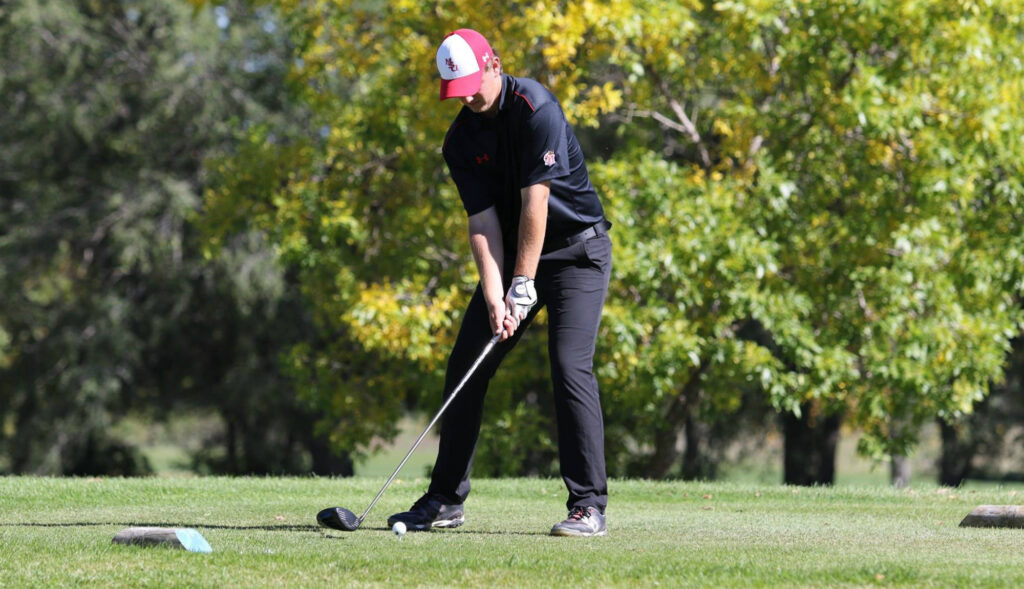
Sure, Jordan Bean would love to brag that he consistently bombs drives past his older brother, Matt.
He doesn’t though. Not many do.
“He likes to rip at the golf ball,” said 16-year-old Jordan of Matt, two years his senior. “Even now, I’m not as far as him and I probably won’t ever hit it as far as him. Growing up, he was outdriving everybody in his own age group.
“But it was good to be able to throw the chirps out if I ever did outdrive him.”
Golf is a gentleman’s game, but the occasional barb and wisecrack is, uh, par for the course in this case of sibling rivalry.
Matt and Jordan are regulars at Canmore Golf and Curling Club, a charming and community-minded hangout in the Canadian Rockies, just a few minutes from the entrance gates to Banff National Park.
But every course has its own set of Bean brothers (or sisters), siblings who never seem to tire of cranking shots on the range and stick together like the Velcro flap on a golf glove.
“If I’m going to practise, I’ll definitely ask him what he’s doing and sometimes I’ll even call him if he’s out and say, ‘Hey, I’m going to practise’ or ‘I’m going to play. Do you want to come?’” Matt said. “And he’ll always say, ‘Yeah, pick me up,’ basically wherever he is. It’s generally something that we do together.”
Puck was their early passion, but the Beans got hooked on birdie-hunting together, with both crediting Jason Schneider’s junior program at Wildwood Golf Course in Saskatoon for sparking an increased interest in tournament play.
In fact, when the family moved back to the mountain town of Canmore after five years on the prairies, Matt stuck with Schneider — still an assistant professional at Wildwood — as his coach.
The brothers improved together, too.
“They were extremely hard-working, extremely dedicated. They spent a lot of hours here,” Schneider recalled. “They always strived to be better, and they always wanted to have that belt at home.”
That’s a boxing analogy, and these matches have become slugfests.
Today, Matt’s handicap factor is +1.5. He just completed his freshman season with the men’s golf program at Minot State University in North Dakota.
Jordan, a lefty who will graduate from high school in 2018 and also hopes to tee it up at the post-secondary level, is a scratch, and he gets one or two strokes off big bro.
“We’ll go on family golf holidays, too, and that’s an opportunity for all four of us to get out and golf together,” said their proud father, Martin Bean. “Usually, (wife) Barb and I are in one golf cart and the boys in the other, because they’re playing from the same tees and we’re a little bit further forward.”

There are not many sports that can bring a family of four together in that fashion.
“We didn’t really get to play hockey together, and it was always one of us being at the rink at this time and the other being at the rink at another time,” Matt said. “So we definitely got a lot closer when we started playing 36 holes a day in the summer and you spend eight hours on the course together. It seemed like there was always something to talk about, because you get your breaks from talking when you’re hitting your shots. So it’s definitely helped bring us together.”
Echoed Jordan: “We strive off each other, to try to beat each other. And I think it’s made us way better golfers than we probably could have been alone.”
Let’s not forget though, these kids can play. Matt finished in a tie for second last summer at the Alberta Junior Boys Championship,
crafting a three-round tally of two-over 215 in crummy conditions at the weather-shortened showdown.
Jordan closed with a red number — a one-under 70 on what turned out to be the last day — and wasn’t many notches down the leaderboard, T16 at 11-over 224. He checked in fifth among juvenile-aged competitors that week.
If one Bean has signed his scorecard and the other is still on the course in a tournament lap, they’ll often loop back with buddies to offer encouragement. It’s telling that one of Jordan’s favourite golf memories is a match that he lost, and not to his big bro.
“We were playing in a match-play tournament in Waskesiu and were paired up together, but we weren’t playing each other,” Jordan said. “I was dormie on No. 18 and knew I wasn’t going to win after I hit my drive a million miles off to the side. Matt was trying to come back in his match. If he lost, I would have to play him the next day, so I was cheering for him to come back, I’ll tell you that much.
“He managed to win by winning the last four straight, and it was one of my favourite moments to watch him play. It was just fun to cheer him on and see him succeed in that tournament aspect. “That’s one that I remember the most.”
Without a doubt, there will be many more memories. Realizing the PGA Tour is “far-fetched,” Matt will major in elementary education, a background that will also come in handy if he pursues a career as a teaching pro.
Jordan has time to ponder his options, but he’s leaning toward business or engineering.
“And being an elementary school teacher,” Matt pointed out, “I’d have my summers off to play golf.”
As long as Jordan lives nearby, he’ll never have trouble finding a game.
“I guess the rounds have become a little bit more serious. We tend to be a bit more focused than we were when we were little,” Jordan said. “But even then, it’s very similar to when we were smaller. We play for a milkshake or something now. But honestly, it’s just us two kids going to the course and having fun and playing together.”
 This article was originally published in the Family Issue edition of Golf Canada Magazine. Click here to view the full magazine
Golf Canada and the PGA of Canada publish Golf Facilities in Canada 2017 report

Golf Canada, in partnership with the PGA of Canada, has released Golf Facilities in Canada 2017—the definitive report on golf facilities and development in Canada.
Golf Facilities in Canada 2017 is a collaborative effort between Golf Canada, the PGA of Canada and the National Golf Foundation (NGF), a golf industry knowledge research firm which delivers independent and objective market intelligence, insights and trends.
The report, which is a follow up to the 2015 Golf Facilities in Canada Report, identifies all existing public and private facilities in the country; and defines supply by province, type and number of holes. The report also includes information on facility openings and closings, as well as the number and type of facilities currently in development.
“The 2017 edition of the Golf Facilities in Canada report provides a comprehensive snapshot of the Canadian golf landscape and the abundance of golf experiences in communities from coast to coast,” said Golf Canada Chief Sport Officer and interim CEO Jeff Thompson. “We are proud to partner with the NGF and the PGA of Canada in presenting the second iteration of this in-depth summary of national and provincial golf facility data.”
“The PGA of Canada in partnership with Golf Canada is excited to present this captivating study of golf facilities in Canada compiled by one of the world’s leading research firms, the National Golf Foundation,” said PGA of Canada CEO Gary Bernard. “As the second oldest and third largest professional golf association in the world, the PGA of Canada and its 3,700 members are proud to be a driving force at golf facilities from coast-to-coast.”
A snapshot of data captured in Golf Facilities in Canada 2017:
- Canada is home to 2,298 public and private golf facilities; ranking it second in the world in total supply.
- Seventy-seven per cent of the total golf supply is located in Canada’s four most populated provinces—Ontario, Québec, Alberta and British Columbia.
- Golf remains extremely accessible in Canada with nearly 90 per cent of the country’s supply open to the public.
- Of the 2,068 daily fee or public facilities in Canada, 48 per cent are located in Ontario and Québec, which together account for 61 per cent of the country’s total population. The two provinces are also home to 73 per cent of Canada’s 230 private clubs.
- Nine-hole golf (838 facilities) accounts for more than 36 per cent of Canada’s total supply. In Saskatchewan, 18-hole courses are outnumbered almost three to one (51 vs. 149) by 9-hole courses.
- Canada features nine 12-hole facilities (six of which are in Ontario) and a single 6-hole facility which is located in Manitoba.
- Resort golf, though a small segment of Canada’s overall supply, is a significant contributor to tourism in several provinces. Countrywide, 169 facilities (or approximately seven percent of total supply) are connected to a resort or a resort/real estate operation.
- Since 2010, 26 facilities have opened in seven different provinces including Alberta, which leads the way with eight openings during that period. In recent years, Canada has seen only moderate growth, and currently has 22 18-hole equivalent facilities in various stages of development.
- Since 2015, 51 facilities have been reported as closed, including 19 in Ontario. Canada’s largest province accounts for 37 per cent of total Canadian closures as well as 35 perc ent of Canada’s total supply.
The complete Golf Facilities in Canada 2017 report including national and provincial data is available for download here.
Globally, Canada’s 2,298 facilities represent seven percent of the world’s total supply of golf facilities (33,161). Canada ranks second in total supply behind the United States (15,014) and is ahead of Japan (2,290), England (1,991), Australia (1,591) and Germany (747) among the countries with the next highest total supply. For more on the world report, visit randa.org.
Men’s Amateur Qualifiers set to start

With the 2017 season in full swing, Alberta Golf has already conducted its Scott Venturo Alberta Open Championship and Alberta Junior & Juvenile Championship U19 & U17 qualifier events. Starting today, and extending to the end of the week, over 250 competitors will compete in qualifiers, across five zones, in order to claim their spot into the Sun Life Financial Alberta Men’s Amateur Championship to be held at the Ponoka Golf Club, July 18th to 21st.
2017 Men’s Amateur Qualifier hosts include: Heather Glen Golf Club (Calgary), Whitecourt Golf & Country Club (North), Old Golf Club (Central) and Vulcan Golf Club (South).
Evan Holmes has been competing in the Men’s Amateur event for a few years now, and is the defending Champion.
“Just a big exhale of relief, really,” Holmes said of his reaction after winning the 2016 Sun Life Financial Alberta Men’s Amateur Championship at Innisfail Golf & Country Club. “It was a lot of hard work paying off. Probably since Sundre (2013 Amateur), it’s been the tournament that I’m always looking forward to every year, to work a little bit harder to get.”

Evan Holmes of Calgary captured the 2016 Sun Life Financial Alberta Men’s Amateur Championship in 2016 at Innisfail.
Ah yes, Sundre, site of the Alberta Men’s Amateur in 2013.
If you’re not familiar with the gut-wrenching details, Holmes owned a commanding nine-shot lead after three days at that event, only to be leapfrogged in the final round and lose by one.
At Innisfail, he fired four straight rounds in the 60s, finishing three shots up at 15-under 273.
“I would obviously rather have two Alberta Ams than one,” Holmes said. “But now that I have won one, it’s definitely a monkey off my back.”
All of this month’s qualifiers including, the Senior Men’s, will finish on June 13th. The deadline to register for the Senior’s competition is June 5th.
View all of the leaderboard results to see who will be competing in the various Alberta Golf Championships this season starting on June 20th. The Alberta Men’s Amateur Qualifying Calgary begins today.
Remembering Sid Puddicombe

Sid Puddicombe with his sons Tod, Mark and Grant at the grand opening of RedTail Landing Golf Club
On June 1, 2017 the Alberta golf industry lost one of its pioneers in Sid Puddicombe. He passed away at the age of 85. Sid would become known as the patriarch of golf course superintendents in Alberta. He got his start watering greens at night in Saskatchewan. His first formal training was provided in Winnipeg by a Canadian turfgrass legend by the name of John B. Steel whose name now adorns the Canadian Golf Course Superintendents Association highest annual award for excellence; an award that Sid proudly won in 1987.
Sid worked at the Saskatoon Riverside Golf Course until 1968. He then moved to the Mayfair Golf and Country Club where he plied his trade until 1988. He was the first to successfully implement covering greens in the winter to enhance spring conditions.
Always one to give back to the game, Sid was well known for mentoring young up and coming superintendents, many of whom became well renowned in their own right. Following along a long line of golf course turf managers, Sid also volunteered his time to the Alberta Golf Association as a director with a role to educating clubs on the tricks of the trade. He started a turf school at the Fairview and Olds Colleges and was instrumental in hosting annual spring conferences with the goal of furthering the conditions of all Alberta golf courses through education.
Sid would later go onto create his own golf course design and construction company. Along with his 3 sons, the Puddicombe’s have influenced the design and construction of a multitude number of courses worldwide.
Sid was inducted into the Alberta Golf Hall of Fame in 2010 under the Distinguished Service Category. See more here.
A Celebration of Sid’s Life will be held Wednesday, June 7 at 3:00 p.m. at RedTail Landing Golf Club Tournament Centre, located at the Edmonton International Airport. – See more
Dustin being Dustin

Dustin Risdon captured the PGA of Alberta Championship at the Edmonton Petroleum G&CC. He continues to play extremely well, winning the PGA of Alberta’s first Players’ Tour event of the season on May 24, 2017.
Junior champion.
Professional golfer.
Caddie.
PGA of Canada assistant.
Teacher.
Dustin Risdon has been there, done that … is doing that. And somewhere along the lines, he’s still finding time to do what he does best— win golf tournaments.
But these days, golf is paying dividends for him in more ways than with just prize money.
These days, the Strathmore native is stress-free and having fun golfing.
Again.
Finally again.
“I definitely lost the fun on a number of occasions,” said the 35-year-old two-time Alberta junior kingpin and 1997 Canadian junior champ, who eventually swung his way to success on the Nationwide Tour, now the Web.com Tour, during a roller-coaster pro golf career. “I wanted to quit the game countless times.”
Good thing he didn’t, in retrospect.
While they may not be events on the Nationwide Tour, of which he played in 46 events from 2003-10, or the Canadian Open, of which he’s played in three over the years, Risdon found his way to a run of wins — and a ton of fun — during the 2016 PGA of Alberta golf season.
First, it was victory at the PGA of Alberta Assistants’ Championship with a two-day 16-under 128 at Mill Woods Golf Club.
Second, it was the PGA of Alberta Championship that saw him shoot a field-best 1-under 71 at Edmonton Petroleum Golf & Country Club.
Then, it was the SunIce Tour Championship at which he carded a two-day 11-under 133 to beat runner-up Wes Heffernan by eight strokes and set a new course record at Sundre Golf Club.
Along the way, he won seven of the eight PGA of Alberta events he entered and finished runner-up in the other.

And in the end, he was tops on the PGA of Alberta’s order of merit and grabbed — of course — its player-of-the-year honour.
It was definitely good times for the oft-reserved Risdon.
“I was having fun most of the time,” said Risdon of the key to his golf success. “When I was travelling, I kind of got the old feelings back staying in the hotel rooms by myself, thinking ‘I don’t want to be doing this anymore.’ Quebec was a real tough one (for a third-place finish at the Quebec Canadian Circuit Pro Tour), because we were way out in the middle of nowhere — I was pretty much isolated by myself, it was a four-day event, and by the end of the week, I was pretty much begging to come home.”
But his crowning achievement of the schedule was yet to come on the shores of Georgian Bay at the Lora Bay Golf Club just outside Thornbury, Ont., where he trounced the field last September to triumph at the PGA Assistant’s Championship of Canada.
“It was relaxing staying at a house instead of being stuck alone in a hotel room — and that helped,” said Risdon of bunking with a friend in a huge home by Georgian Bay. “It’s a different feeling when you’ve got someone there with you there all the time, so that made life easier.”
Indeed, Risdon rode a stress-free week to a three-day, 18-under 198, beating the nearest competition by an event-record 11 strokes to collect a $9,000 paycheque. The first two rounds of his 67-67-64 effort helped Alberta win the 36-hole inter-zone competition — again in record fashion — at the national tournament.
“I was kinda building up to that — won a few tournaments going in,” Risdon said. “The year before, I had a bad first round. I felt like I could’ve won that tournament, but I actually felt a little nervous playing at a national championship again, even though it wasn’t the Canadian Open.
“So I went in last year thinking I can play with these guys and shoot 6-under each round. I shot 5-under the first round, and I told (the PGA of Canada reporter), ‘I’m one shot behind my goal — I want to shoot 6-under every day and finish 18-under’ — and his eyes went wide open. I birdied the last three holes to finish 18-under, and he was the first guy to say, ‘Holy, you did it!’
“So just the mind was right. I had a place to stay, and I had a buddy caddying for me — I was comfortable.”
These days, he’s most comfortable teaching the game to others as an associate teaching professional at National Golf Academy in Calgary.
Risdon brings, of course, a wealth of not just knowledge but the experience of having played high-pressure golf in the top ranks of the sport. It all makes him the perfect teacher.
“The first thing I teach in a lesson is we’re going to keep this as simple as possible, so you can go out and have some fun,” Risdon said. “They’re not going out on tour, so let’s get a golf-swing groove that you can go out and rely on. And I teach them how to self-diagnose, so they don’t have 18 different thoughts in their head before they hit the ball.”

He’s especially keen on mentoring those young talents with a chance, perhaps, to follow in his footsteps.
“You can’t perfect this game — you lose 99% of the time,” said Risdon, who’s also spent time working in the much-ballyhooed junior program at Collicutt Siding Golf Club in Carstairs. “It’s hard to explain the mental side. That’s why I go out and play a lot of lesson holes with the juniors. I’ll go out and show them how to play the course and offer course management and the mental experience.”
“You never say never when it comes to playing again — but for now, it’s teaching,” added Risdon, who can be reached at dustin@nationalgolfacademy.ca. “I’d like to become more of a coach — my ultimate goal is to help juniors along that are getting ready to go to college and help them get their scholarship. I didn’t have too much of that growing up. I had a lot of offers, but I didn’t have a lot of guidance. I want to re-do what I did with other kids and get them on the right track.
“If I can get them there and get them on their way, that would be gratifying to me.”
Dustin being Dustin
This article was originally published in the 2017 edition of The Alberta Golfer Magazine. To view the full magazine, click here.
Edmonton centenarian Ken Darlington shooting his age at golf course
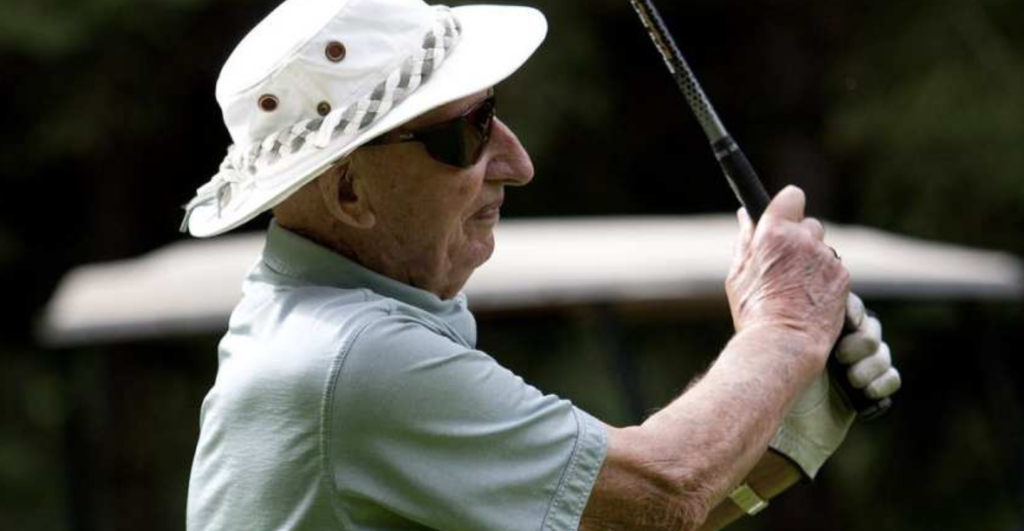
Ken Darlington shot a 100 a couple of weeks ago at Riverside. Then he shot a 99.
So what’s so interesting about that? Well, how about this: Darlington is 100 years old and those two rounds were the 339th and 340th time he has shot his age.
“It’s miraculous that a guy is still playing golf at 100 let alone still shooting his age,” said Dunc Mills, a rules official of the Alberta Golf Association.
“That’s incredible.”
“Good heavens. I had no idea I had shot my age that many times,” replied Darlington. “I’ve been lucky.”
Lucky? Hardly. A guy who shoots his age 340 times is not lucky; he’s just that good.
While Darlington, who seemed to shoot his age just about every round when he was approaching his 90s, didn’t know the extent of his achievements, it was Stu Orr, president of the Riverside Senior Men’s League where Darlington plays, who uncovered all of the numbers.
“At Riverside alone Ken played 1,367 rounds and shot his age 280 times. That means every time Ken tees up his ball he shoots his age or better more than 20 per cent of the time.
“Amazing. Absolutely amazing,” said Orr, who said he saw somewhere on the internet that the percentage of golfers that shoot their age is just 0.0000089.
“I’m not sure how to say this but near as I can figure it means not many,” laughed Orr, who believes that the reason Darlington shoots his age so often is because of his chipping.
“He chips it to five feet from the pin and then he putts it in. And here I am four-putting.
“And he can still hit his driver 200 yards. And straight.
“Ken is my hero. He’s also a fantastic person. He’s as easy going as anyone you’ve ever met.”
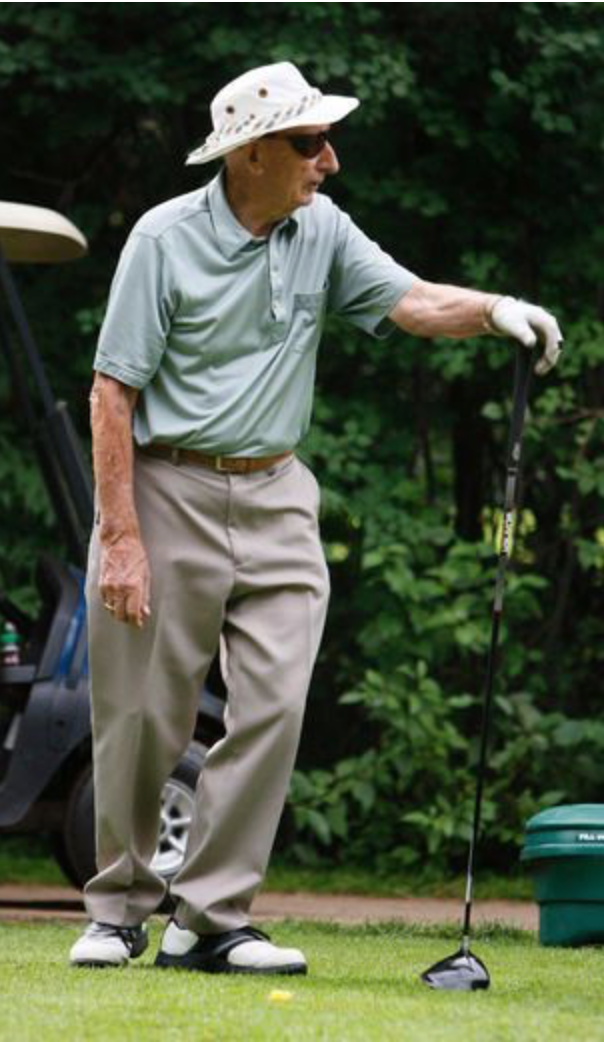
Jim Dove, 90, who regularly picks up Darlington and then plays with him, believes Darlington’s success is his lob wedge.
“He’s deadly from 60 yards. He doesn’t get to most par 4s in two so he has to rely on his lob wedge.
“Ken and I hit our tee shots about the same distance and our second shots are usually within 10-12 feet of each other too.
“But then Ken gets out his lob wedge and it’s all over.”
Orr and Dove and several other friends of Darlington were going to hold a surprise 100th birthday party for Darlington a few weeks ago. Unfortunately, Darlington’s health prevented him from attending.
“My heart has been acting up and I’m short of breath,” said Darlington, who was born in Essex, England and came to Canada with his family in 1928. “I also get so tired. What can I say? I’m getting old.”
Working for the government in the agricultural department, Darlington said he never really took up the game until he retired in 1985.
“Before that I might have played one or two rounds a year.
“But then I met Jim Dove and some of his friends and Jimmy asked if I would come out golfing with them. I guess I must have liked it because we used to play about four times a week,” said Darlington, who has had a heart attack, quadruple bypass surgery, a detached retina and has an artificial aorta.
“Lucky,” he said again.
“I’ve had a lot of fun.”
Originally published in the Edmonton Journal – May 28th, 2017