


Wampum
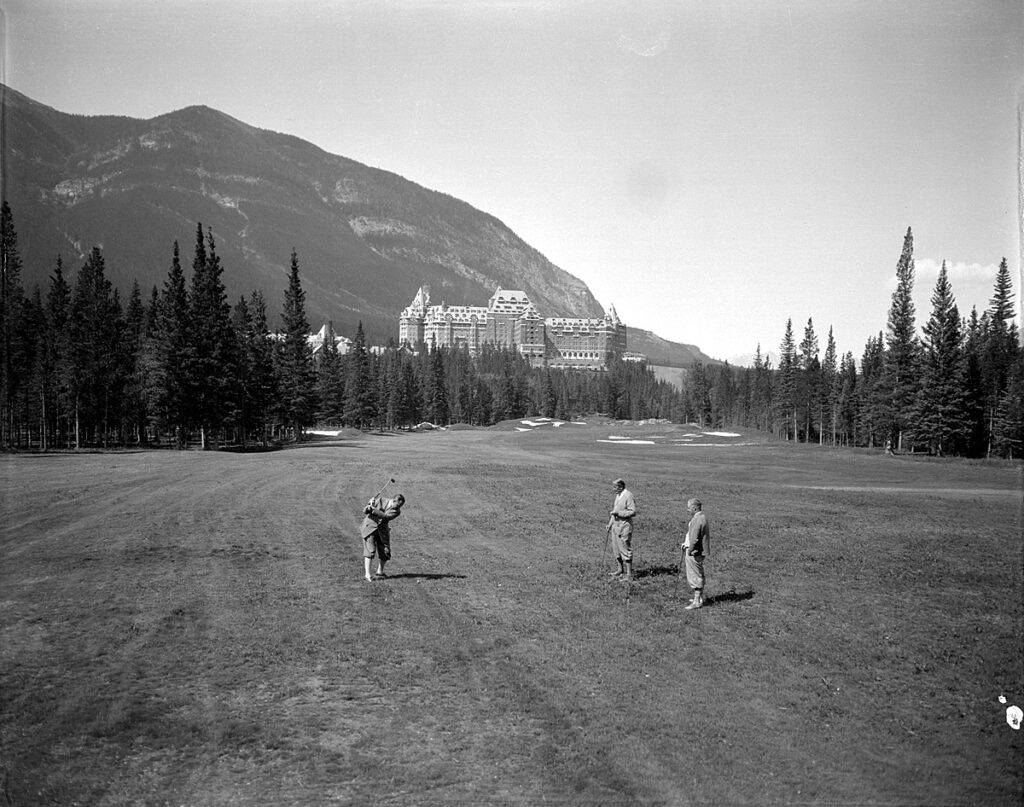
If you had to choose one hole, one view, to put on a poster celebrating Canadian golf, which hole would you choose? From Newfoundland to Vancouver Island, there are many iconic holes in Canada that could be considered. But for many golf aficionados in our country, the answer would be easy: the 14thhole at the Fairmont Banff Springs Golf Course – Wampum.
Designed by Stanley Thompson in 1928, the tough-as-nails 14thon the famous layout has it all. A par-4 that tips out at 440 yards, it is, without a doubt, a beautiful summation of what golf in the Canadian Rockies is all about. And it’s a quintessential hole – a poster child! – in Canadian golf.
The historic, castle-like fortress of the Fairmont Banff Springs Hotel rising on the ridge high above the green, undoubtedly, is the hole’s most potent attribute. However, with the thundering cascade of Bow Falls on the right, the gently-bending pine-lined playing corridor, and the exceptional architectural characteristics of the hole, including an artistic swarm of ragged bunkers left and right of the green, there are many aspects of the hole that make it a true gem. And with all that eye candy – not to mention the intense challenges it presents – playing Wampum is alwayshighly memorable.
Originally the closing hole on the classic “Golden Age” layout, the 14this still, for many, the pinnacle of the round. True, the sublime “Devil’s Cauldron,” the par-3 4th, may get more love from the scribes and photographers. That’s understandable. It’s been considered one of the world’s great par-3s for 90 years. When you consider the stunning setting of that hole – the emerald pond, the natural bowl that cradles the green, the clutch of bunkers – it’s hard to downplay the significance, the near perfection, of “the Cauldron.”
However, as awesome as the 4this, the regal 14th, arguably, packs a more powerful punch. It’s the hole that gathers together all the key ingredients that make this Stanley Thompson course – the first course in history to cost one million dollars to build – a true Canadian icon, a masterpiece in global golf.
The location of the 14th(and, remember, this was Thompson’s “grand finale” in the original route) is, obviously, the key to its success. “When Thompson was commissioned to build the course in 1928 there was a campground in this location,” says Steve Young, Banff’s Director of Golf. “But Thompson fought tooth and nail with Parks Canada to move the campground so this hole could be built. Long story short, he got his wish.”
In fact, in the end, moving the campground opened the door for a handful of “new” holes to be built, including, of course, his ideal closing run along the river and the storied opening hole (now the 15th) on an aerie ledge adjacent the hotel. Not surprisingly, given the affection many people still have for the original routing, the course regularly pays homage to Thompson’s original vision by offering the “Heritage Golf Experience” each year.
Not surprisingly, along with the compelling creation of this great hole, which is called “Wampum”, are many great moments throughout its long-running history. Fittingly, in the 2006 Canadian Skins Game – the contestants were Stephen Ames, John Daly, Greg Norman, Sergio Garcia, and Jack Nicklaus – the course was played in the original routing. For everyone on hand, a lasting memory of this exhibition was watching the great Jack Nicklaus, in one of his final competitive appearances, stroll up the 14thwith the soaring Rockies and the grand hotel in the background.
And, long before that, during the filming of River of No Return in 1953, the most famous actress of the time, Marilyn Monroe, strolled the fairways of Banff and filmed a scene near the 14thhole. (She made costume changes in an old building adjacent the 14thfairway – the building is gone but the foundation is still visible). Numerous other famous people – Joe DiMaggio, Bob Hope, Clint Eastwood, Henry Fonda, Bing Crosby, Bobby Locke and Winston Churchill, to name just a few – have also strolled down the 14thfairway and, no doubt, been “wowed” by the surreal beauty.
Regardless of how well you play the hole, Thompson’s exquisite shaping and powerful vision for the conclusion of the round is still the pinnacle of the golf experience at Banff. And, whether it’s a bogey or a birdie (or something in that vicinity), rest assured, the grand beauty here – punctuated by the majestic “Castle of the Rockies” looming high above – will be a rich reminder of where your good fortune has brought you.
 Wampum
This article was originally published in the 2018 edition of The Alberta Golfer Magazine. To view the full magazine, click here.
Strong Alberta contingent starts season at Future Links, driven by Acura Pacific Championship

Kicking-off the season today thirty of Alberta’s junior boys and girls are competing in Victoria B.C. for the Future Links, driven by Acura Pacific Championship, from May 11-13.
The junior girls representing Alberta this weekend include Annabelle Ackroyd, Tillie Claggett, and Victoria Tse. The junior boys squad consists of Connor Ackroyd, Marko Banic, Jordan Bean, Cian Besler-Chalcroft, Matthew Betker, Chase Broderson, Ethan Choi, Ethan de Graaf, Connor Dunlop, Benjamin Farrington, Carter Graf, Mason Harder, Rory Huycke, Kai Iguchi, Naoki Iwasaki, Nicholas Mah, Callum McKay, Bradley McKeating, Brady McKinlay, Max Murchison, Jace Ouellette, Brodie Shields-Tyler, Thomas Sluka, Reid Svendsen, Elias Theodossopoulos, Hunter Thomson, Ben Wong.
The 54-hole stroke play tournament begins at Bear Mountain Golf Resort with practice rounds for the competitors on May 10. The tournament action began at 7 AM (MT) on May 11.
“The guys only played a few holes yesterday during the practice round as it rained hard for a few hours. We ended up over at another course later in the evening hitting balls and practicing short game” said Randy Robb, high performance coach, who is travelling with the team.
“Seven of the junior boys tee off between 7:50 and 9:30 this morning and the conditions look perfect out here,” said Robb. “There are some interesting groups such as Carter (Graf) and Ben (Farrington) are paired together for the first two days and Ethan (Choi) is with a top Team Canada development player. We also have a couple girls to watch as Annabelle (Ackroyd) and Tillie (Claggett)will tee it up later this morning.”

Taking the field this weekend 88 junior golfers in the junior boy’s division will be competing. The top six will earn exemptions into the 2018 Canadian Junior Boys Championship on July 30- August 2 at Medicine Hat Golf & Country Club in Medicine Hat, Alta.
Within the junior girl’s division, 32 golfers play this weekend with the top six earning an exemption into the 2018 Canadian Junior Girls Championship on July 31-Aug. 3 at Beach Grove Golf Club in Tsawwassen, B.C.
The event features a total of 120 U19 competitors with a total of thirty Albertans on the roster. The championship will conclude on Sunday, May 13 with weather reports calling for a warm sunny weekend. Access to the entire schedule and leaderboard is available here.
Susan White, the Tournament Director and Senior Manager of Field Operations for B.C Golf says “the Future Links, driven by Acura Championships, are fantastic opportunities for Canadian junior golfers to demonstrate their skills. We look forward to seeing this substantial field of juniors challenge the Valley Course.”
There are five additional Future Links, driven by Acura Championships will span the country this summer.
- May 25-27 – Future Links, driven by Acura Ontario – Otterville, Ont. – Otter Creek Golf Club.
- June 1-3 – Future Links, driven by Acura Western – High River, Alta. – Highwood Golf & Country Club.
- June 8-10 – Future Links, driven by Acura Québec – Lachute, Que. – Club de golf Lachute.
- June 15-17 – Future Links, driven by Acura Prairie – Portage la Prairie, Man. – Portage Golf Club.
- July 17-19 – Future Links, driven by Acura Atlantic – Port Blandford, Nfld. – Clare Golf & Country Club.
ABOUT THE COURSE
Bear Mountain’s Valley Course opened in 2009 and was designed by Nicklaus Design Group Inc.
The signature features of the course are elevated tee-boxes, large undulating greens and striking views of Vancouver Island.
Junior Boys: 6,691 yards, Par 71
Junior Girls: 5,985 yards, Par 72
Junior golf takes major strides in Alberta indigenous community

Canadian culture extends its arms to welcome people of all race, ethnicity and background. A nation rooted in diversity, accessibility and inclusiveness has molded Canada into the one of the most accepting nations in the world. Now golf—with a new pilot program aligning junior golf life skills with student learning outcomes—is taking steps to make the sport more accessible in First Nations communities.
Golf Canada, working in conjunction with the PGA of Canada and The University of Ottawa, has partnered with Indigenous Northern Affairs of Canada (INAC) to pilot the Future Links Driven by Acura Golf in Schools program at Alexander First Nations, a community northwest of Edmonton, Alta.
A first of its kind pilot program integrating golf’s Life Skills with student learning outcomes, the Golf in Schools pilot ran from January through April at the Kipohtakaw Education Centre, supporting school curriculum and community engagement of students through golf.
For Golf Canada Chief Sport Officer Jeff Thompson, the Alexander First Nations pilot is an important step and learning opportunity in the continued growth of golf among underrepresented communities across Canada.
“First Nations engagement with golf represents an important growth opportunity for our sport in communities across Canada and we are extremely proud to be conducting this initiative in partnership with Indigenous Northern Affairs of Canada,” said Thompson. “Earlier this year Golf Canada proudly embraced a new policy around Inclusiveness, Accessibility and Diversity. This pilot program supported by INAC is a meaningful application of that policy which we believe has great potential to connect Golf Canada and our partners with more First Nations golfers and make the sport more inclusive.”
Vice Principal Suzzy Park shares her thoughts on the new #FutureLinks First Nations Pilot program ⛳️ pic.twitter.com/Rxklt3qEO3
— Golf Canada (@TheGolfCanada) May 9, 2018
In February, the PGA of Canada partnered with Golf Canada to host a Community Golf Coach workshop with eight participants at the education centre in Alexander. Over two days, teachers and community members were trained in golf fundamentals and tactics to help establish a safe, welcoming environment for junior golfers.
“With many people in Alexander golfing regularly and loving the sport, it made sense to partner with the PGA of Canada and Golf Canada to allow for growth of the sport in the community,” said Jody Kootenay, Director of Education with Alexander First Nations. “We have some amazing youth who could very well take their love of golf and make it more competitive. We wanted to allow for the sport to have not only coaches available to the youth, but to start showcasing pathways for the golfer who is just starting out—we wanted to ensure our children had that chance.”
An important feature of the Golf in Schools program is the Life Skills component which focuses on transferrable lessons—both interpersonal and intrapersonal—that can be applied outside the golf space in peer groups, at home, and within the community.
The Intrapersonal Life Skills—perseverance, goal-setting and emotional regulation—are meant to instill focus while the Interpersonal Life Skills—honesty, teamwork and respect—embody a sense of sportspersonship.

The University of Ottawa led the introduction of Life Skills integration with Golf in Schools and have since identified areas where the transfer of Life Skills are made in everyday activity. A student survey was conducted prior to the Alexander First Nations pilot to further the understanding of Life Skills applications in Canadian communities.
“Working with the Alexander First Nations was a meaningful step forward as we look to further expand the reach of golf in Canada,” said Glenn Cundari, Technical Director with the PGA of Canada. “We both learned a lot from each other and had some good laughs along the way.”
More than 50 students at the Kipohtakaw Education Centre are participating in the daily Golf in Schools unit during their Physical Education classes. Golf Canada and the PGA of Canada are working to organize a teaching professional to deliver an in-school lesson as part of the Get Linked initiative, ultimately strengthening the golf community in Alexander.
The Golf in Schools program is equipped with a teacher-friendly learning resource to assist in the delivery of lesson plans for six components: Learning Outcomes, Equipment, Warm-Up, Task Development, Closure and Method of Assessment. The kit includes safe, age-appropriate golf equipment for all three tiers of the program: elementary, intermediate and high school.
As the Alexander First Nations pilot nears completion, Golf Canada is investigating opportunities to partner with additional First Nations communities to help grow the game. Since the launch of the pilot, nearly a dozen First Nations communities have expressed interest in integrating golf into their community programming.
To learn more about the First Nations golf initiatives or submit an application for consideration, please contact Adam Hunter, Golf Canada’s Manager, Grow the Game at ahunter@golfcanada.ca
Fun Formats for the Spring
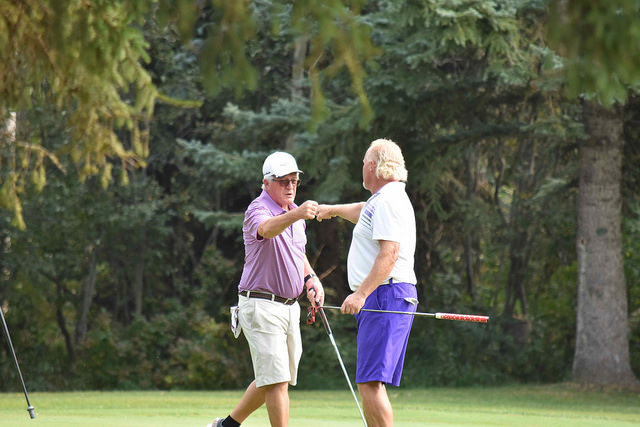
As I was growing up, my friends and I were always outside playing games. Most revolved around sports but at times there were some very intense imagination games played. The one constant were the rules but the wildcard was how to play under those rules and that’s what amped up the fun level.
When it comes to the game of golf, players can apply the same logic and make that Saturday/Sunday morning round a touch different from the 18 hole, play your own ball format.
Craig Loughry, with Golf Canada, suggests trying something other than stroke play and see how that fits into your regular tee time. You might get more than just your foursome playing along.
“Any version of that where you’re partnering and just taking the best shot of yours or your partner’s that obviously helps in including more people in I guess what you might call a social competition. It can get serious but allowing the higher handicap players be part of a team, they will be more likely to say yes to that competition than on their own where they might feel a little intimidated.”
Match play is the simplest alteration to you just playing your own ball. You go one on one with another player using your handicaps to level the playing field. You can also use match play as a foursome to partner up with another player and use a best ball format to go hole by hole.
He says partnered events are starting to creep into courses around Canada more often these days as one-off events and he’d like to see it become more of an every-day play type of thing in our country.
“Countries like Scotland and Ireland, they play most of their golf partnered. They do play a lot of match play but they do a lot of partnered events,” he said.
A popular version over seas is the alternate shot format with both partners teeing off and from there you choose which ball to play and alternate shots until you hole out.
“You can imagine what that does for pace of play there. They play fairly quickly over there for a lot of reasons but one of them is because they are playing foursome type events and that’s just for normal, everyday play.”
There are plenty of versions of scrambles to choose from and it can be a full field of players taking part or Loughry says take one day and make a change to how you play your round. For some high handicap players, it might take away some of the pressure they might feel playing with lower handicap golfers.
“When you introduce the concept of a partner, you have someone to lean on. The neat thing about partnered events is it also works the other way,” he said. “So, if your partner hits a bad shot, they may leave you in a bad spot and you might feel a little more pressure but at least you’re able to have a better chance of being in a better spot on the golf course when you do have a partner.”
Loughry says the partner style of golf is not something you see in North America for the most part and he’s not sure why it doesn’t pop up on a more regular basis amongst foursomes out for their daily or weekly round.
“It’s still golf. Why not try something a little bit different?”
Another foursome competition called Wolf is another option. At the start, the teeing order is decided by flipping a tee and the order is rotated (on the first hole 1,2,3,4, on the second hole 2,3,4,1, on the fifth hole 1,2,3,4, again and so on).
The Wolf is always the last player teeing off each hole and then he selects a player to be his partner for that hole or he can go it alone against the other three. If the Wolf and partner win the hole, each gets two points. If the non-wolf partners win they get three points each. If the Wolf wins the hole playing alone he/she gets four points and if another player beats the lone Wolf then all players except the Wolf get a point.
Another version is having partners chosen by the two shots which are left of the fairway and the two which are right. Then you can play a best ball or alternate shot with the lowest score getting the point.
No matter how you slice it (pun intended), shaking up that regular round of golf can be fun, interesting and challenging.
Other than a golf ball and maybe some pocket change, what have you go to lose?
Get Golf Ready
This article was originally published in the 2018 edition of The Alberta Golfer Magazine. To view the full magazine, click here.
The R&A seeks feedback from Canadians

The R&A is currently doing some research to find out about use of the www.randa.org website and what could be done to improve its website in future.
They are asking golfers, from Canada and abroad, to take a few minutes of their time to share their thoughts. It doesn’t matter if you have visited The R&A website in the past or not.
Please bear in mind they are seeking feedback specifically on the www.randa.org website rather than The R&A app, other publications or The Open website.
Please click here to start the survey.
This survey is being administered by SPORTS MARKETING SURVEYS INC. on behalf of The R&A. Any responses you give will be anonymous and confidential and will only be used in aggregate form for research purposes. No personally identifiable information is collected as part of this survey.
Hogan among 5 Canadians to earn status at PGA TOUR Canada Q-School

COURTENAY, B.C. —Amateur Jake Shuman claimed medalist honours at the fifth and final Mackenzie Tour – PGA TOUR Canada Qualifying Tournament at Crown Isle Resort and Golf Community, shooting a final-round 68 to edge fellow American Brinson Paolini. William Griffin finished third.
Shuman was under-par in each of his four rounds, playing the par-5s in 13-under, birdieing all eight in the final two rounds.
The Duke senior birdied his first hole of the final round before giving one back on the third. The product of Needham, Massachusetts, quickly bounced back, making birdie at the fifth and sixth before making his final bogey of the tournament, on the seventh.
From there on in, Shuman played marvelous golf, sandwiching a birdie on 13 between circles on his scorecard at Nos. 10 and 15, closing the day with three pars for the victory.
“If that’s not the best tournament I’ve ever played, it’s one of the best,” said Shuman, following his round.
Putting heat on Shuman down the stretch was Paolini, another Duke alum. After making nine pars on the front nine, Paolini birdied 10 and then made three in a row from the 15th to the 17th to get within one shot of Shuman.
Paolini had a 20-foot look for birdie on the 18th that narrowly slid by the hole as he settled for the runner-up position.
Griffin pieced together three of the best rounds of the tournament, highlighted by his second-round 65, including an ace that gave him the lead going into the third round.
Griffin battled back Friday from his third-round 73, capping a bogey-free 66 with a 15-foot birdie putt on 18.
Amateur Grant Hirschman, a senior at the University of Oklahoma, finished fourth, and fellow amateur Chandler Blanchet, who tied for fifth alongside Nicholas Pandelena, won a playoff to receive status through the first eight events. Pandelena receives status through the first four events.
Canadian Riley Wheeldon paced the Canadian contingent in the field, closing at 11 under par to finish with a share of seventh place. Growing up in Comox, B.C., Wheeldon has played a number of rounds at Crown Isle, with Friday’s round one of his more important ones. A winner on the Mackenzie Tour in 2013, Wheeldon shot his second 67 of the week to jump 13 spots. Wheeldon will be exempt for the first eight events, subject to the second reshuffle.
Four other Canadians finished between 17th and 40th to earn conditional status for the 2018 campaign:
- Brett Hogan (a) | Calgary, AB
- Jake Duvall (a) | Victoria, B.C.
- Bret Thompson | Winnipeg, Man.
- Devin Carrey | Burnaby, B.C.
Click here for full scoring.
Canadian golf industry launches “National Golf Day”

OTTAWA – Today, Canada’s national golf industry associations announced the first annual National Golf Day, May 29, an event aimed at raising awareness to the public and government decision makers on the many positive impacts of the golf industry.
“More Canadians play golf than any other participation sport and our industry is #1 in driving economic impact, employment and charity fundraising,” said Jeff Calderwood, National Allied Golf Associations (NAGA) and We Are Golf Chair. “Combined with golf’s diversity, healthy fitness benefits and environmental stewardship, we really do have such a positive message to communicate.”
National Golf Day provides the opportunity for Canada’s golf industry leaders to discuss these wide-reaching benefits of the sport directly with MPs, Senators and policy advisors at Parliament Hill. A May 28 evening reception will also be held in Centre Block, and NAGA will be hosting a day of interactive golf activities on the front lawn where MPs and visitors will be able to participate. This day of outdoor golf activities will include a focus on junior golf.
“We are really looking forward to our time in Ottawa and expect that government officials from all parties will be impressed to learn about all the ways golf contributes in virtually every riding throughout Canada,” added Golf Canada CEO Laurence Applebaum. “There are so many meaningful benefits that golf delivers in communities from coast to coast and it will be great to share all those insights on National Golf Day.”
Golf courses and all related stakeholders throughout Canada are encouraged to promote the same positive messages. NAGA will provide shareable social content.
NAGA is also announcing a rebranding of its public facing name to We Are Golf. This aligns with the same brand name used by the American golf industry for allied association activities such as National Golf Day. NAGA does carry on as the administrative body but will use the We Are Golf brand for all public communications.
Please watch for additional We Are Golf and National Golf Day communications over the coming weeks as we lead up to the May 29 event itself.
For more information on We Are Golf, visit wearegolf.ca
At just 20, Henderson on pace to become most decorated Canadian pro golfer

Brooke Henderson is just three wins away from becoming the most decorated Canadian professional golfer of all time – and she’s only 20 years old.
After her sixth career LPGA Tour victory Sunday at the Lotte Championship in Hawaii, the native of Smiths Falls, Ont., is on track to eclipse the Canadian-high mark of eight wins, held jointly by Sandra Post, Mike Weir, and George Knudson.
“It’s actually amazing, when I think about it, that I’m this close already,” said Henderson from Los Angeles, where she is competing this week. “I’d love to get a couple more wins this season and go from there.”
Post, who was 31 when she notched her sixth victory, said Henderson has adapted well to the lifestyle of the LPGA Tour. Henderson’s early success hasn’t shocked the Canadian Golf Hall of Famer.
“I’m really not that surprised,” Post said by phone. “She’s always had a tremendous amount of talent and she loves to compete.”
Henderson is in just her third season as a pro, but said it’s becoming increasingly difficult to win on the LPGA Tour. There have been no two-time LPGA winners yet this season, while on the PGA Tour three golfers have already won twice.
“I feel like every week coming down the stretch on Sunday there are six people within a shot of the lead,” she said. “Last week was a little different, which was nice for me, but every other week I feel like anybody can win.”
Henderson dedicated her win to the community of Humboldt, Sask., and will be playing with the Humboldt Broncos in her thoughts through the rest of the season after a deadly crash involving the hockey team’s bus led to 16 deaths and 13 injuries.
Smiths Falls is approximately the same size as Humboldt, and she said she has a unique connection to a small town that supports its hockey team.
“Hockey is so important to almost every Canadian, I would say, and definitely Smiths Falls is a hockey town,” she said. “I think it gave me that little extra motivation and extra mental strength to keep pushing and try to get that win not only for me but for them as well.”
Although Henderson has four top-10 finishes this year, she sits 13th in the world rankings.
She admitted she is a bit of a victim of how many events she plays, as standings in the world rankings are determined by dividing total points earned by the amount of events a golfer plays. But is eager to get into the LPGA’s elite group.
She said getting into the top 10 of the world rankings along with getting into the top six of the season-long Race to the CME Globe are her two goals for the near future.
Post said Henderson will likely focus her attention on trying to win majors, as she’s already proven she can compete week in and week out on the LPGA Tour. The big events will have special meaning for her moving forward.
“There will be certain tournaments, like the CP Women’s Open, that she’ll aim at a little bit more,” Post said. “The big thing is to keep her enthusiasm and keep that fire lit as long as she can, and stay healthy.”
After this week in Los Angeles, Henderson will play the next two weeks, in San Francisco and Dallas, before the LPGA Tour has a week off where she will return to Smiths Falls and participate in a charity event in Ottawa.
Henderson said she would likely take the week off prior to the U.S. Women’s Open, the next major on the LPGA Tour schedule, to prepare.
She’ll play at her home course in Florida to get used to the warmer temperature and the different grass she’ll have to play on at the host course, Shoal Creek Golf Club in Birmingham, Ala.
“Hopefully I can win again soon,” Henderson said. “With the amount of talent out here, and the amount of players that don’t get a lot of credit, it’s going to be a tough challenge. But I’m ready for it.”
Team Canada’s Jaclyn Lee of Calgary ties scoring record and wins Big 10 Championship

MAINEVILLE, Ohio – Calgary’s Jaclyn Lee etched her name in the history on books on Sunday, tying a 54-hole scoring record at the Big 10 Championship en route to a four-stroke victory.
Lee, a three-time National Amateur Squad member, went wire-to-wire at TPC River’s Bend, kickstarted by an opening-round 66—the lowest score of the tournament. The Ohio State junior followed with a second-round 68 and battled through a tense final round which saw her lead shrink to as little as one.
“This means a lot to me,” Lee said, greenside at the 18th. “It was a goal that I set at the beginning of the year and I’m so happy to achieve it. After coming in to the final round with a five-stroke lead, things got a little nerve-wracking today but I’m glad to walk away with the title. To tie the record and have my name in the history books is pretty cool, too.”
The win marks the third NCAA title of the year for the 20-year-old—she collected victories at both the Westbrook Spring Invite and the East & West Match Play.
Your @bigten champion, @JaclynLee57!! ??? pic.twitter.com/RPzkSgKwHH
— Golf Canada (@TheGolfCanada) April 22, 2018
Collectively, the Buckeyes finished fourth at 1 over par. Lee will lead the Buckeyes into the NCAA Regionals, getting under way on May 7.
Click here for full scoring.
Handicapping: Active seasons
For many of us trying to squeeze in the last few rounds of the season, or for those planning on heading south this winter, it’s important to note the “active season” in the region, province or country you’re playing in.
Golf Canada’s Handicap System stipulates every player is responsible for returning all acceptable scores into one’s scoring record from rounds played on courses observing their active season, which is part of the golf season when courses have acceptable playing conditions.
Ultimately, it is the responsibility of authorized provincial golf association to declare active and inactive periods, and it is the responsibility of the area club and golfers to observe these dates for posting purposes.
Each year, provincial associations analyze numerous factors to determine their active seasons. This ensures consistency of when scores would be posted by the majority of golfers to help keep Handicap Factors accurate.
Scores made at any golf course observing an inactive season are not acceptable for handicap purposes. The rationale behind this is that posting scores during inactive seasons (periods of poor course conditions) could artificially increase a player’s Handicap Factor.
Scores made at a golf course in an area observing an active season must be posted for handicap purposes, even if the golf club from which the player receives a Handicap Factor is observing an inactive season. The club’s Handicap Committee must make it possible for a player to post these away scores at the beginning of the active season.
For example, if a player belonging to a golf club in Ontario plays golf in Florida during January, any scores made in Florida are acceptable and must be returned to the player’s Ontario golf club. If the player is also a member of a golf club in Florida, scores must be posted to the player’s Florida club.
In Canada, the active season in each province is as follows:
BC = Mar. 1 – Nov. 15
AB = Mar. 1 – Oct. 31
SK = Apr. 15 – Oct. 31
MB = Apr. 15 – Oct. 31
ON = Apr. 15 – Oct. 31
QC = Apr. 15 – Oct. 31
NS = Apr. 15 – Oct. 31
NB = May. 1 – Oct. 31
PE = Apr. 16 – Nov. 14
NL = Apr. 1 – Nov. 30
It’s also important to note that if you are travelling to other countries, you should determine their active seasons to prevent posting unacceptable scores. Your home club needs all acceptable scores from the “off-season” as well to ensure your Handicap Factor is accurate once recalculated at the beginning of the season.
For a detailed list of active and inactive schedule in the United States, click here.
For more information on handicapping, click here.