


Spring Golf Reminders: Common Rules Scenarios

After a long winter, and two weeks of false starts across the province, it looks like golf might be back in Alberta! With early spring conditions, players might come across some common rules issues and we’re here to try and clear these up before they happen.
Definitions
-
Abnormal Course Conditions
Under the Rules of Golf, an abnormal course condition is anything that is futher defined as either, a animal hole, ground under repair, immovable obstruction, or temporary water. During the spring, ground under repair and temporary water are the most common for a player to encounter.
-
Ground Under RepairAbnormal Course Condition
Any part of the golf course that the committee determines to be ground under repair. Areas deemed as ground under repair will likely have white spray paint around it and any attached or growing object that is within the inside of the white circle is part of the ground under repair.
Ground Under Repair can also be defined by physical features or using stakes.
-
Loose Impediments
Defined as any unattached natural objects such as:
- Stones, leaves, loose grass, branches, and sticks
- Dead animals or animal waste
- Worms, insects, or similar animals that can removed easily, and the mounds or webs they build
- Clumps of compacted soil (including aeration plugs)
During the spring, it’s important to note that Dew, Frost, and Water are not loose impediments. Snow and Natural Ice however can be treated as loose impediments or temporary water with discretion being given to the player on how to proceed.
-
Preferred LiesCommonly known as “Winter Rules”
Preferred Lies are commonly known as winter rules, but this rule permits golfers to lift, clean, and place their ball if the course implements it. This is common when the course is still wet from the snow thawing or after a heavy rainstorm
-
Temporary WaterAbnormal Course Condition
Any temporary accumulation of water on the surface of the ground. It is not enough for the ground to be wet, muddy, or soft, instead this accumulation of water must remain present either before or after a stance is taken.
Common Situations and Questions
-
My ball is sitting on a patch of dirt with no grass – do I get relief?Ground Under Repair Or Not?
Before taking relief you need to know if the golf course has determined that the area is in fact ground under repair. It’s common when playing a casual round with friends to make these determinations amongst the group, but it’s up to the golf course to make this determination ahead of time and clearly mark it with paint, stakes, or both.
-
Are aeration holes considered ground under repair?Ground Under Repair Or Not?
Aeration is a common practice in the spring to help the course’s get into shape. Aeration holes are not considered ground under repair, unless the golf courses implement the specific local rule that allows this.
Any clumps of compacted soil including aeration plugs however are loose impediments and can be removed by golfers.
-
When can I remove loose impediments around my ball?Loose Impediments
You’re allowed to remove loose impediments anywhere on the golf course including the fairway, a bunker, or even on the putting green. Review the definition above of what a loose impediment is.
It’s important to be careful when moving a loose impediment however, because if the ball moves and you’re anywhere on the course other than the green or teeing area you will incur a penalty of one stroke.
-
The bunkers still have water in them, how do I proceed?Temporary Water Relief
If you end up in a large accumulation of water in the bunker you are entitled to relief from this abnormal course condition. The relief must be inside the bunker to not incur a penalty or you can take a one stroke penalty and take it out of the bunker on a straight line back from the pin and where the original ball was. If you can’t find complete relief from the water, you will have to find the point with maximum relief from the water.
-
What happens if my ball is sitting in temporary water outside of a bunker?Temporary Water
If your ball is in an abnormal course condition rough (like ground under repair or temporary water) in the fairway or the rough, players are entitled to free relief. Find your nearest point of relief and you get one club length from here to create your relief area.
-
How does a preferred lie work?Preferred Lies
If the course determines that the grass is really wet or muddy, they’ll let players know that preferred lies are in effect. The course will also determine what areas of the course the rule applies to, and the size of the relief area given (i.e. a scorecard length from the original spot.
If preferred lies are put into place, depending on what the course institutes, players can mark their ball, lift it, clean it, and then place it back within the determined relief area.
To help continue your learning, use the links below to learn more!
Helpful Resources
Nearest Point of Complete Relief Video (Ground Under Repair and Temporary Water Relief)
How to Best Use the Rules of Golf to your Advantage
This article was originally published by the USGA.
Ask golfers how the Rules of Golf impact their round, and almost all will say that they add strokes to their score. It’s not an unreasonable perspective. We are conditioned, especially in sports, to view rules as things to avoid breaking so we won’t be assessed some sort of penalty.
An offensive lineman holding a defensive end? Ten-yard penalty. Whack a player’s arm on his way up for a layup? Two-shot foul. A catcher’s glove interferes with a batter’s swing? Automatic first base.
Yes, there are penalizing elements of the Rules of Golf, but that’s not the end of the matter. Knowing the situations where the Rules can be used to your advantage can save you from difficult predicaments, and it’s a great way to enhance your golf experience and maybe even lower your score.
Are you taking advantage of these scenarios when you tee it up?
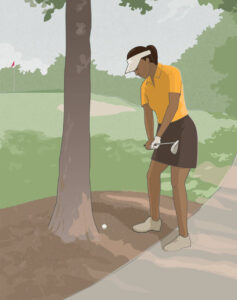
Right-handed player taking relief for playing a left-handed shot
The scenario: An errant tee shot comes to rest beside a tree that impedes your ability to take your normal swing. You decide your best option is to punch the ball back into play using a left-handed swing but in doing so, you’re now standing on the cart path.
The question: Since a left-handed swing is not your normal stance, would you be allowed to take free relief from the cart path?
The answer: Yes, because using an abnormal swing doesn’t preclude you from taking relief as long as the stroke you’re trying to make isn’t clearly unreasonable. Proceed by finding the nearest point of complete relief using a left-handed stroke. From that spot, you get a one-club-length relief area to drop the ball in.
The best part? After completing the relief procedure, you are then free to use a normal right-handed swing.
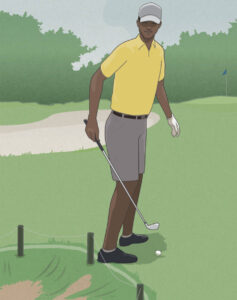
The scenario: Your golf course is working on the drainage system in the middle of a fairway. Your tee shot avoids the marked-off repair area, but your stance doesn’t.
The question: Can you take free relief when the ground under repair interferes with your stance and not your ball?
The answer: Ground under repair is treated the same as a cart path in that if you have interference with your lie, stance or swing, you can play it as it lies or take free relief by finding the nearest point of complete relief and dropping a ball within one club-length of that spot.
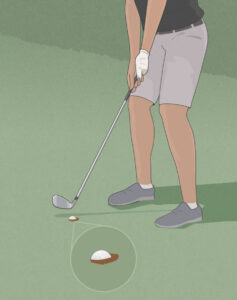
The scenario: A rainstorm left the course wet and soft. You crush your first tee shot down the middle of the fairway but when you get to your ball, you see that it’s plugged in its own pitch mark.
The question: Am I allowed to pick the ball up and take a drop for my second shot or do I have to play it as it lies?
The answer: You could play it as it lies – but why when free relief is allowed? Take your drop within one club-length of the spot right behind the ball that’s in the general area. You also have the option to clean the ball or change it out for a new ball.
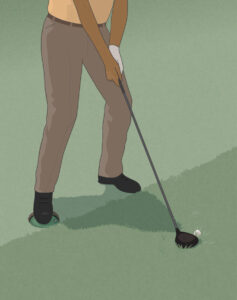
The scenario: You draw a bad lie in the rough, but a sprinkler head interferes with your stance. You wisely decide to take free relief. While your nearest point of complete relief is in the rough, you realize that your one club-length reaches the fairway.
The question: Are you allowed to take free relief from the rough and drop it in the fairway?
The answer: Absolutely! In fact, this is the exact scenario used in Clarification 16.1/1 in the Rules of Golf to illustrate that this is permissible. The rough and fairway are part of the same area of the course – the General Area – and if taking relief results in you getting better conditions, then it’s your lucky day. Feel free to drop and take your next shot.
To learn more about the Rules of Golf: