


Golf Canada Foundation Heritage Grant Program Launched
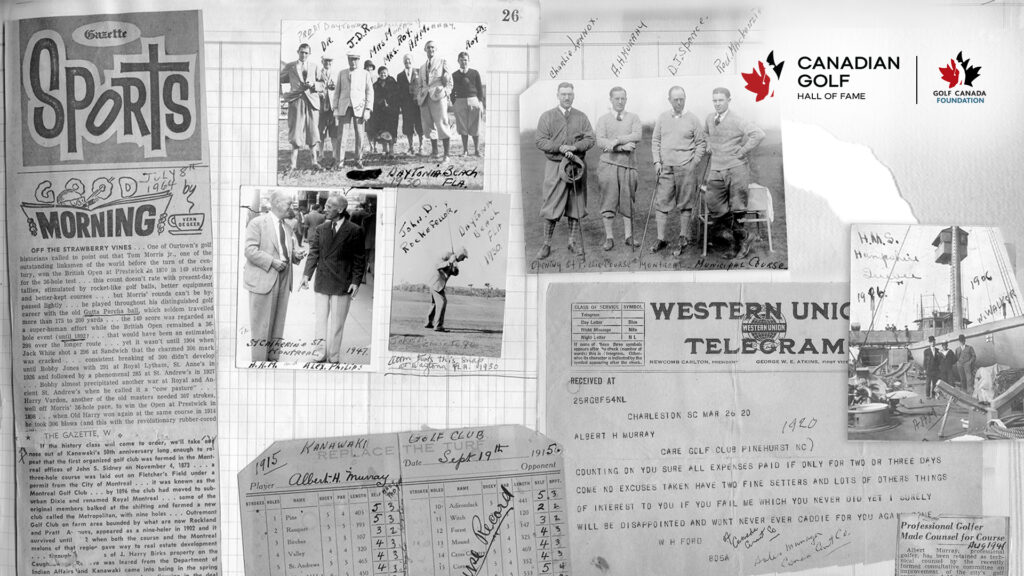
Story was taken from the Golf Canada website
OAKVILLE, On. – The Golf Canada Foundation and the Canadian Golf Hall of Fame are proud to announce the creation of the Golf Canada Foundation Heritage Grant Program.
The newly established Heritage Project Grant will provide financial assistance of up to $2,000 to support community heritage projects related to the game of golf in Canada.
“We are excited to announce the launch of the Heritage Project Grant and appreciate the generous support from our donors and partners with the Golf Canada Foundation for making this possible,” said Meggan Gardner, Director, Heritage Services, Golf Canada. “Bringing to life the history of various golf events and competitions, its champions, and most importantly, the community that golf creates, is what this grant will support.”
Heritage Projects that would qualify for the Heritage Project Grant can include, but are not limited to:
- Collection and digitization of historical documents, photographs and artifacts related to golf in Canada.
- Conducting oral history interviews with golfers, historians and members of the golf community.
- Dissemination of findings through a dedicated website, community events and social media channels to engage the public.
- Supporting the publishing of printed or electronic history books and websites.
The Heritage Project Grant is open for applications to all Golf Canada members (golf course, facilities and individual members). The deadline for applications is Friday, March 27, 2026. To apply for the grant and review specific evaluation criteria, please click here.
For more information on the Heritage Project Grant, please contact Meggan Gardner at mgardner@golfcanada.ca.
Alberta Golf’s Ghost Stories – Edmonton Country Club

Halloween may have come and gone, but Alberta’s golf courses are never short on ghost stories. One of the most haunting belongs to the Edmonton Country Club — the province’s oldest private golf club, established in 1896. Over its long and storied history, the club has witnessed it all: moves, renovations, robberies, and even murder.
Among those who once worked within its walls was Phyllis Carter, a dedicated cook who was in her first season at the club. But her life — and her marriage to Reginald Carter — would take a dark and tragic turn, forever tying her spirit to the very place she served so faithfully.
To this day, staff and guests alike have seen, heard, and felt the presence of spirits through the clubhouse after dark. Some say it’s nothing more than old stories… but others swear that Phyllis and Reginald Carter still walk the grounds.
Read on to uncover the chilling true story that left its mark on the Edmonton Country Club, from the club’s 125th anniversary publication.
The Story
In 1952, the club was still on the outskirts of the city, with employees often spending extended periods before heading back home. That was the case with Phyllis Carter, who was working in her first season as a cook at the club, having come to Canada from Essex, England, in 1951. Given the club’s proximity to the city, Carter lived in the staff quarters near the main clubhouse. Carter’s 18-year-old daughter also worked at the club.
On the morning of Friday, August 22, Carter’s husband, Reginald, a construction worker, appeared unannounced at the club, which was quiet. What led Reginald to head to the club is unclear; newspaper accounts provide no details as to his motive. Rumours at the club suggested he may have been concerned his wife was having an affair with the groundskeeper. Regardless, what played out after his arrival was shocking and generated headlines.
Thomas Molyneaux, the club’s head professional, saw Reginald there in the morning. Not that this was out of the ordinary-Reginald was known to visit his wife occasionally. Reginald stood by his car near the club gates and waved at Molyneaux as he walked towards the clubhouse.
Phyllis Carter had already been working for several hours by this point, having served breakfast to the staff before heading back to the clubhouse for more provisions.
The police contended Reginald Carter confronted his wife in the clubhouse, stabbing and strangling her. No one at the club was aware of what was happening, according to accounts. Later that morning, Molyneaux walked over the bridge that connected the tee to the 18th green, and saw a noose hanging on the bridge, but nothing else. Strangely, he doesn’t appear to have made much of this discovery, and it apparently didn’t concern him.
However, around noon, Peter Stiksma, who worked on the grounds crew, found Phyllis’s body. The Edmonton Journal accounts suggest there were two murder scenes— one in the kitchen, and one in a bedroom located nearby, indicating Phyllis may have tried to evade her husband. The paper said she was discovered “fully clothed,” with a butcher knife in her back and a sweater knotted around her neck. Frank O’Rourke, who also worked in course maintenance, saw the noose tied to the bridge, and unlike Molyneaux he was concerned enough to investigate, where he found a body in the ravine below, which police had difficulty getting down to remove. In all, it was a horrible scene.
Putting the situation together, it would appear Reginald confronted his wife, murdered her, and then, feeling remorseful, hanged himself on the bridge. However, Reginald had used a rope that was far too long in his suicide and was decapitated by the force of having dropped so far, which explains why there was a noose on the bridge, but no body. “The daughter, who spent Thursday night in the city with a sister, was informed of the tragedy when she returned to the club at noon Friday,” the paper reported.

An obituary in the Edmonton Journal noted the couple were survived by four children. The murder of Phyllis Carter created one of the great legends at the club: that her ghost continues to haunt the clubhouse to this day.
The Haunting
For decades after her death – right up until the time of writing of this book (2021) – staff and the occasional guest have been frightened by an apparition that many feel resides in the clubhouse. Those who have experienced the ghost say there’s a common thread -the presence is a woman in proximity to the kitchen.
On a chilly fall evening in 2003, Matthew Walker was busy with a small drywall job in the dining room. Everyone was gone for the day, and the radio was his only companion. Matthew had his back to the dining room as he worked, when he suddenly felt someone looking over his shoulder. He turned to see who it was this late in the evening. But no one was present, and he resumed his work until the same feeling came over him once again, only more strongly.
He quickly turned. But again, no one was there. He turned off the radio and began to listen, determining there were “chopping” sounds coming from the kitchen. Then he suffered something he had only read about in books – he was paralyzed by a shooting sensation up his spine and back of the neck. Instead of finding out who was in the kitchen, he backed away, grabbed his gear, and went home.
Matthew finished the wall the next day when there were plenty of people around. He looked in the kitchen with the General Manager Brad Pinnell to see what machine could make that sound and nothing fit. But Brad took Matthew seriously, as he’d had his own experience the year before.
In the spring of 2002, Brad and a server were the first to arrive for the day. With fresh coffee prepared, Brad went to grab a cup. He chatted amiably with the waitress about the day’s duties, all while doctoring his brew. The dining doors were wide open, and as Brad fixed his coffee and kept up his chatter, a woman walked past in the dining room. Grabbing his coffee and stirring as he went, Brad followed the woman into the dining room. But when he finally looked up, no one was there. Brad stood in confusion, gaping at the empty scene in front of him. Just then from behind him, the waitress entered the dining room. “The hair stood up on the back of my neck,” he said. It was a feeling Brad had never before experienced. He wondered who that woman had been.
The figure made itself known to many staffers over the years, including Assistant Manager Shirley Chalmers, who began work at the club in 1984. She was often alone in the office late in the evening, and during her first year on the job, she’d often hear chopping sounds from the kitchen or footsteps in the upstairs of the clubhouse, even though no other employees were working. For about five months, Shirley was the only occupant in the office when one fall evening she heard the unmistakeable banging sounds of someone sitting at the empty metal desk.
The experience unnerved her and she simply went home. But the issue continued and after one such experience, she approached General Manager Leo Blindenbach to ask what the cause of the noise might be. Blindenbach told her employees had often encountered what they felt was a ghost in the clubhouse, but it didn’t appear to have any hostile intent. Interestingly, that settled Chalmers’s nerves, and she was no longer bothered by the strange noises in the clubhouse. However, Phyllis might not be the only ghost that haunts the clubhouse.
On at least two separate occasions, wedding guests walking out on the bridge in the evening have told of seeing a headless body floating over the bridge. The visions have come with feelings of anger and despair.
In the fall of 2012, Beth Baker and a co-worker were working in the Snack Shack when they were spooked so badly, they had to flee. The music they were listening to began skipping songs and they heard a voice, apparently in mid-air, saying words they couldn’t decipher, leading the pair to run to the safety of the clubhouse.
Their experience isn’t unique; the staff working in the building at the end of the bridge often feel they are being watched, and many times locked doors swing open on their own. A few times, books fell off shelves, or the paper towels would unravel by themselves. Baker said her worst scare was at closing time on a calm Sunday evening in the fall. She heard the banging of the wooden table that was leaning against the back of one of the coolers.
Knowing it couldn’t make a sound without something moving it, Beth went to text her coworker about this latest ghostly incident. As she grabbed her phone, she felt someone blowing on her face. She sprinted outside, extremely shaken by the incident. After composing herself she went back to continue the closing up but felt the mood in the shack was angry and she was not welcome. She had to get someone from the clubhouse to help her conclude her tasks.
There are many stories of this nature and without records, it’s difficult to know when they began. But most people feel it’s related to the Carter deaths. A longstanding club surely has its ghosts, but in the case of Edmonton Country Club, they seem all too real.
The History of the Men’s & Women’s Amateur Trophies

Alberta Golf Hall of Famer, Betty Stanhope-Cole, with 2007 Women’s Amateur Champion, Nicole Forschner.
Alberta Golf, or formerly known as the Alberta Golf Association, has been around since 1912 running our provincial championships for over 100 years. Throughout our history we’ve seen many great champions whether it’s been Betty Stanhope Cole and her impressive record of 16 Alberta Women’s Amateur wins, or Bob Wylie, Keith Alexander, and Doug Silverberg’s historic amateur careers. We’ve had impressive young players blast on to the scene like Doug Lecuyer winning the Alberta Junior three times in four years, and the year he didn’t win he claimed the Alberta Men’s Amateur. We’ve had young people like Jessica Luciuk and Kareen Qually-Nelson who won everything Alberta had to offer and began representing Canada as part of our International Teams.
While many people know the names of the winners, many don’t know the history of what they’re winning. Alberta Golf has had a variety of different championships over its history whether it was the Edmonton Journal Trophy, the original trophy for the Open, the Calgary Herald trophy for the Country Districts Championship, or the Pepsi Cola Junior Trophy. Over time lots has changed, been renamed, sponsors coming and going, trophy plaques and names being changed and removed. The two that have been remained the same from the start are the Men’s Amateur and the Women’s Amateur, and this is their story.
The Alberta Men’s Amateur, the highest prize in the province for the male amateur golfers has been around since before even the Association began. Before the AGA got its start there were two clubs, the Edmonton Country Club and the Calgary Golf & Country Club, who began hosting a competition to name the provinces top golfer. In 1908 the first ever Alberta Men’s Amateur was played at the Calgary Golf & Country Club and was won by hometown favourite Charlie Hague, an Alberta Golf Pioneer, who helped lay the foundation for the great amateurs to follow. Hague was a Calgary banker who despite his provincial success liked to stay out of the limelight. This would be out of his control in 1921, when he was the runner up in the Canadian Men’s Amateur. He quickly became a fan favourite as he came back in every match, he played including the final, where he was five down through the first 12 holes and rallied to force extra holes in the 36-hole match. Hague’s showing put Western Canada on the golfing map at a time when golf was ruled by the east.
Hague continued his winning ways in Alberta throughout the early years of golf in Alberta. He won three of the first four unofficial Men’s Amateurs. Officially in 1912, the Alberta Golf Association was founded by The Lethbridge Country Club, The Edmonton Country Club, the Calgary Golf & Country Club, Fort Macleod Golf Club, and the Calgary St Andrews Golf Club. It was with this event the Association named its first executive all of which are considered pioneers of the sport in Alberta. Coinciding this was our first official Men’s Amateur which was won by non-other than Charlie Hague of Calgary. This is the first mention of a cup of some kind being given to the winner, and it was named the C.W. Cross Cup.
The Cross Cup was the original cup awarded to the winner of the Men’s Amateur.The cup was donated by none other than Charles Wilson Cross. Cross was born in Ontario in 1872. He received a variety of education culminating in his BA and LLB degrees from Osgoode Hall. After articling at a Toronto law firm, he moved to Edmonton in 1897 and became a Liberal MLA in 1905 working in politics till passing away in 1928. Cross’s connection to golf was he was a member at the Edmonton Country Club during his time in Alberta. Cross donated the original Alberta Men’s Amateur trophy and his legacy in golf will be forever felt because of this.
The Cross Cup remained as the crowning achievement of winning the Men’s Amateur for the years to come and is still prominent as it sits atop the current base today. In 1976, the trophy base was changed and renamed to the Charlie F Scott Memorial Trophy after C.F (Charlie) Scott. Scott was a huge part of sports in Alberta generally speaking. Moving to Calgary as a baby, Scott played hockey, baseball, and football in his youth. He turned to golf in his twenties, where he played a part in the founding of the Inglewood Golf Club in Calgary and won two club championships there before moving to Edmonton after the Second World War. While in Edmonton, he became the president of the Edmonton Golf Association and helped create the first Edmonton Open in 1949. At the same time, he became the secretary of the Alberta Golf Association and held the position for twenty years. Through his time, he saw the rise of many of Alberta’s great champions including the junior careers of Silverberg, Wylie, and Alexander among others. In 1971, the Calgary Booster Club named Scott the Sportsman of the Year because of his work with golf, curling, and football. Scott resigned from his secretary role and in 1976, to honour a man who devoted his life to sport, the Alberta Golf Association proudly named its most coveted prize after him.
Today, the Men’s Amateur proudly boasts the C.W. Cross Cup on top of the Charlie F. Scott Memorial Trophy which will be once again handed out to the top male amateur in the province, with the winner’s name adding an additional chapter of history to one of Canada’s oldest trophies.
The Women’s Amateur trophy, just like the Men’s is seen as the epitome of amateur golf success in the province and has been around for just as long. The Women’s Championship has been competed for as long as the Men’s with the first winner coming in 1907 won by Mrs. W.N. Clark. This too was an unofficial championship until 1912 when the Alberta Ladies Golf Union was born. Refusing to join the growing the Canadian Ladies Golf Union as a provincial branch, the Alberta Ladies continued running their own Women’s Amateur championship for nearly a quarter century. While not much is known about this time, many of the winners of the ALGU’s championship are early pioneers of the women’s game of golf in Alberta like Janet Sparrow, Mrs. J.R. Henley, and Mrs. W.E Milner. At the time ladies were competing for the McKay Cup a coveted prize, which was donated by the Watson Bros Jewelry store. The Watson Bros. were a popular choice in the early 1900’s, even being commissioned to help create the temporary parliamentary mace in 1906. The Watson Bros commissioned a carpenter to create this mace out of wood, and while it was always going to be temporary the mace was used until 1956.
While the ALGU continued running it’s own championship for the province, the Canadian Ladies Golf Union was hard at work trying to create a chain of provincial branches of it’s own. Originally started by Florence Harvey, a Canadian Golf Hall of Fame member from BC, in 1913 the Canadian Ladies Golf Union was created to provide the women in Canada access to the British Ladies Golf Union and their handicapping system. Until this point, the RCGA was running a Canadian Ladies Amateur championship by themselves. In 1921, the CLGU met at the Canadian Ladies Amateur and decided to adopt their own constitution and began the process of recruiting provincial branches.
In 1928, the ALGU finally decided to join the CLGU as its Alberta branch. At this time, they needed a new trophy to represent their joining of the CLGU. In comes the trophy we have today, and often seen as the best trophy in the Alberta Golf trophy case, the Sheffield Cup. The Sheffield Cup was also donated by a local jewellery store known as Jackson Bros. Jewellery in Edmonton. This pioneer jewellery store was started in 1906 and closed in 1933. Being around for 27 years, the Jackson Bros. created a wide range of jewellery including war pins. The unifying piece in all their jewellery was their signature logo which is proudly displayed on the Sheffield Cup. There’s no clear connection between the three brothers who ran the store and the CLGU or golf in general, their insignia is hard to miss. While there’s still a lot of unknown about this trophy it’s still a coveted prize and was first won by Mrs. Milner and would be held by other golfing legends like Paddy Arnold, Irene Horne, Betty Stanhope Cole, and Rae Milligan Simpson throughout our history.
Today, the Women’s Amateur proudly and beautifully displays its own history with the Jackson Bros. logo front and centre for all to see. The next chapter in its history patiently awaits its next winner which will be crowned over July 1st to 3rd with a host club yet to be announced.
Friends Before Foes: The Culture of the Men’s Senior Championship

The Interprovincial Challenge Cup was the first interprovincial team championship conducted by the RCGA in 1882 and was far from a true interprovincial championship with only member clubs from Ontario and Québec playing. Five years later these matches ended abruptly. It wasn’t until 1927 that the event was brought back for good. In 1962, the Men’s Senior Interprovincial Championship got its start with only three teams playing in the event. Over the next 15 years the event would continue to grow and in 1977 the Phil Farley Memorial Trophy was created for the winning team of the event.
In the 62-year history of the event, two provinces have seemingly separated themselves from the rest of the field in terms of victories; Ontario and Alberta. Ontario was extremely dominant since the event began, until 1986 when Alberta’s newest crop of seniors arrived. In 1985, Bob Wylie won his first Canadian Men’s Senior Championship and in 1986, Alberta won its first Men’s Senior Interprovincial Championship. Alberta would finish 3rd in 1987 and would then win the next 4 interprovincial championships and seven of the next ten. This was part of a historic run that saw the previous dominance of Bob Wylie, Doug Silverberg, Keith Alexander return on the Senior stage. This group would finish with 8 team wins and 8 individual wins from 1986-1995. The years to follow were ruled by Ontario, with provinces like Quebec, British Columbia, and Nova Scotia winning the occasional title or two.

1988 Men’s Senior Interprovincial Team Winners: Bob MacDonald, Len Brayton, Doug Silverberg, Bob Wylie
Alberta’s luck changed in 2005 with a second-place finish, which kickstarted a run of almost 20 years of podium finishes for Alberta’s senior men. Over the last 19 years, Alberta has two 4th place finishes, one 3rdplace finish, and nine championship wins including six of the last seven. The recent success of Alberta on the interprovincial stage at the Canadian Men’s Senior has been led by five players in Alberta with each team having some combination or inclusion of these players who have helped shape the current landscape of men’s senior golf in the province. The reason for their success; the culture at the Alberta Men’s Senior Championship, and an intense focus on the team event at the national event.
Howard Broun and Frank Van Dornick are seen as trailblazers and leaders at the Men’s Senior Championship in Alberta and an argument against this is hard to come by with 14 interprovincial team championship appearances between the two of them. Howard’s team won the championship in 2006, the first since 1996, and describes the feeling of winning as one being extremely proud of your province.
“It can almost feel better winning the team championship than the individual at times because you’re proud of the team and your province”
When asked about the recent success and how it seems to have started, Howard had a clear answer:
“Frank. Frank (Van Dornick) has been so good for so long and we’re lucky to have him. He kind of dragged the rest of us along and elevated the field around him”.
Frank Van Dornick is not a new name in Alberta, with a storied career including his induction into the Alberta Golf Hall of Fame. His addition to the senior circuit certainly helped boost the competitiveness of the field in the early 2000’s. Frank won five interprovincial championships with the Senior team from 2012 to 2019 and believes it’s a true honour to be a part of this championship story that he has helped create in Alberta.
“It’s terrific to watch truly. The guys I came with valued the team portion and we have a lot of pride within that. The guys put the team first and the competition second. The guys love it.”
The team spot for a Canadian event is always a coveted position by any competitive golfer in Alberta. What separates the Men’s Senior Interprovincial team is the level of camaraderie that comes with the team. Brian Laubman who is another highly decorated competitive golfer in the province always comes to the tournament with the goal of making the team in his mind.
“It’s just different at the Senior’s, guys don’t care as much about the team aspect at the Willingdon (Amateur Interprovincial Team). You can see the change at the Mid-Amateur level, but the Senior’s it goes the full way”
As someone who has played at a high-level throughout his career, he discussed that compared to the Willingdon Cup team, where the players are a little more serious, and the Mid-Amateur teams where you start to get to know the guys but are not close friends yet. “The Senior teams are much closer as you’ve been playing with these guys for 40 years” Laubman explained “at the Canadians, all the Alberta players and their wives are hanging out together and coming together as a group”. He feels that the culture at the Men’s Senior level is what separates them and has helped build this legacy of success.
Ken Griffith, who didn’t make the team this year but is no stranger to winning the Farley trophy, explains the culture that Laubman points out. “These are all my friends, and we might be competitors, but I’m happy and proud of them”, and he adds “I stayed and watch the groups finish up like others had done for me and I was one of the first people to go over and celebrate with them”.
Griffith explains that the culture that has been created for the Men’s Senior Championship is a testament to “the work that Alberta Golf has done to grow our high-level competitions” and he sees the sport moving in a positive direction, especially at the Senior level.
“Being on the team 6 years and winning 4 golds and one silver in that span, what an accomplishment to have multiple championships in this short period of time, it’s a memory I will hold on to for the rest of life.”
Griffith adds that “Making any Alberta team at any level is a great honour, it’s a great accomplishment. It’s a great rivalry we have at our level because we’re all good friends.” Most importantly though Griffith knows it’s about the competition and enjoying the challenge.
“Going to Nationals and competing against the other teams and setting our goals so high is always a lot of fun. It’s an added pressure and we all enjoy the challenge.”

2023 Men’s Senior Interprovincial Team Winners: Ken Griffith, James Varnam, Brian Laubman
Senan Foley is one of the “new guys” at the Senior level and was informed eloquently by Howard Broun how different it is. “There’s more appreciation and thankfulness on the Senior circuit” he recalls Howard telling him. Senan made the team in 2021 and 2022 and was on it again in 2024. “Being on the team, it adds to the week because you’re there to represent something bigger than just yourself” he notes. The honour of a team spot is not lost on any of these players, as Senan puts it “There’s some added pressure for sure, but pressure is a privilege”.
Looking to this year, the Men’s Senior team found themselves four back from Ontario after the first day. Laubman recalls calling a team meeting with Foley and David Schultz knowing that they had to get it done.
“You don’t want to be the team that loses for the other guys before you, it’s about keeping that legacy going” Laubman explained. Foley expressed similar sentiment, “No one wants to let last year’s group down and we take it very seriously”.
Led by an impressive 68 from Foley on Day 2, who was in so much pain from his elbow that he didn’t know if he could finish the front 9, and David Schultz who felt he had to rally around Senan’s hot hand, Team Alberta brought home their 4th straight Phil Farley trophy.

2024 Men’s Senior Interprovincial Team Winners: Brian Laubman, David Schultz, Senan Foley
David Schultz is another familiar name, as an Alberta Golf Hall of Famer and a decorated golfer at every level in Alberta, and he mentions how every year it feels like they have one of the best teams there.
“You know if you come out as the team from Alberta, you know that we have a really good chance and should always be one of the favourites.”
The culture at the Men’s Senior in Alberta seems to be the key to the success at the team event every year and all the players will tell you the same thing. Schultz mentions that everyone keeps in contact over the winter and how everyone is excited to see each other in the summer.
In 2025, the camaraderie of the Men’s Senior Championship will once again be on display at Wolf Creek, as the men will begin the process of preparing to defend their title and continue the legacy that was created before them. Who makes the team in 2025? Can Alberta win five in a row, making it eight in nine years? What we know is the preparation has already begun, and the Men’s Senior Championship will bring camaraderie, excitement, and a winning tradition.