


Level Up Your Mental Game This Summer
The sport of golf requires a strong mental game due to its nature. Its pace leaves time to overthink about past and upcoming shots and it is often played individually, leaving each player solely accountable for their performance. Without proper mental training, these factors can quickly have a negative impact on your game. While golf is a physical sport, the mental component is equally important, as it directly influences physical performance. Below are 5 ways to improve your mental golf game.
Positive Self-Talk
It is easy to let negative thoughts take over following a bad shot; however, consistent negative self-talk can lead to overthinking and a lack of confidence. Alternatively, positive self-talk helps build confidence and reinforce belief in yourself and abilities. Bad shots happen to everyone, but how you respond determines the rest of the round. Additionally, negative self-talk occurs even after good shots, as we are our often our toughest critics. Thus, it’s important to recognize the good as it comes through positive self-talk.
Having a Growth Mindset
In relation to positive self-talk, adopting a growth mindset is one of the best ways to strengthen your mental game. Ignoring a bad shot prevents you from understanding what went wrong and limits your ability to learn. Ask yourself questions such as, “What went wrong?” and “What can I do to avoid it next time?” These questions allow you to turn a bad shot into an opportunity to grow your knowledge and skillset. Plus, this is another way to implement positive self-talk into your round.
Play One Hole at a Time
Each round of golf takes time, so it’s easy to get caught up in previous and future holes. Another way to improve your mental game is by focusing on the present hole. Dwelling on past or overthinking future holes can lead to a crowded mind, distracting you from the present. Staying present and focusing on one hole at a time allows for a mental clarity allowing your preparation to guide your shot. While you can reset after each shot, every hole will have its own process. Remaining focused on the hole you are playing allows you to stay within your process.
Develop a Pre-Shot Routine
An effective pre-shot routine does not need to be complicated or lengthy; rather, it should act to reset and prepare you for the shot ahead. Whether it involves visualization, taking a deep breath, or other concentration techniques, developing a routine that works for you is key to your success. Taking the time to follow your pre-shot routine ensures your focus remains on the shot ahead as opposed to any distractions. A pre-shot routine does not need to look the same for every shot. Different variables impact each shot, so allow yourself space to adapt your pre-shot routine to ensure you are prepared for the moment.
Focus on the Journey, Not the Outcome
While the outcome plays a role in our learning, our primary focus should be on the journey taken throughout a round. A round of golf takes time, so it is important to focus on the actions throughout and how they led to the outcome. Acknowledging the successes, challenges, and in-between moments allows you to learn from mistakes while reinforcing effective actions. Maintaining positive self-talk is key during reflection as it leads to a growth mindset as opposed to a fixed one.
Throughout all these actions, you are building up one of the largest strengths a golfer can have—resilience. The ability to bounce back at any given moment is crucial as it builds confidence. While these techniques may seem overwhelming at first, implementing them gradually allows you to build your mental toolkit over time. Improving your golf game starts with the mental foundation that supports your physical performance.
Spring Golf Reminders: Handicapping Definitions You Should Know

With courses opening again this week and active posting season beginning back in March for Alberta, we have some important reminders about your handicap to keep in mind when you play those first few rounds!
Active Season
The Active Season is the period during which course conditions are suitable for generating acceptable scores for handicapping purposes. Any score recorded within a specific province during its Active Season will be included in your Handicap Index.
In Alberta, our active posting season is already underway. It begins March 1 and goes until October 31.
Most Likely Score
The most likely score is used when a golfer begins a hole but doesn’t finish it. This is especially common during cold weather rounds when players pick up more often.
To determine your most likely score, take:
- The strokes you have already taken (including penalties), plus
- The estimated number of extra strokes you would likely require to complete the hole from your current position.
The Rules of Handicapping include recommended guidelines. For example, if you’re within 5 feet, add 1 stroke; if you’re between 5 and 20 feet, add 2 or 3 strokes.
Playing Conditions Calculation (PCC)
The Playing Conditions Calculation (PCC) becomes especially relevant during Canadian winter and shoulder seasons. PCC automatically recalibrates Score Differentials on days when course conditions are notably harder or easier than usual. If the scores posted that day show that players, as a group, performed worse than expected, the PCC may adjust by +1, +2, or +3. Conversely, if scoring was better than anticipated, it may adjust by -1.
The best part? PCC is fully automatic through the Score Centre.
Expected Score
The procedure for calculating a Score Differential using an expected score can be summarized as follows:
1. An expected Score Differential for the hole or holes not played is calculated, based on a given Handicap Index and a course of standard difficulty.
2. A Score Differential for the holes played is calculated using the player’s actual scores and the rating value of the holes played.
3. The Score Differential from the holes played is combined with the expected Score Differential to produce either a 9-hole or 18-hole Score Differential.
*Expected score can only be calculated if the round is entered Hole-by-Hole in the system*
Spring Golf Reminders: Common Rules Scenarios
After a long winter, and two weeks of false starts across the province, it looks like golf might be back in Alberta! With early spring conditions, players might come across some common rules issues and we’re here to try and clear these up before they happen.
Definitions
-
Abnormal Course Conditions
Under the Rules of Golf, an abnormal course condition is anything that is futher defined as either, a animal hole, ground under repair, immovable obstruction, or temporary water. During the spring, ground under repair and temporary water are the most common for a player to encounter.
-
Ground Under RepairAbnormal Course Condition
Any part of the golf course that the committee determines to be ground under repair. Areas deemed as ground under repair will likely have white spray paint around it and any attached or growing object that is within the inside of the white circle is part of the ground under repair.
Ground Under Repair can also be defined by physical features or using stakes.
-
Loose Impediments
Defined as any unattached natural objects such as:
- Stones, leaves, loose grass, branches, and sticks
- Dead animals or animal waste
- Worms, insects, or similar animals that can removed easily, and the mounds or webs they build
- Clumps of compacted soil (including aeration plugs)
During the spring, it’s important to note that Dew, Frost, and Water are not loose impediments. Snow and Natural Ice however can be treated as loose impediments or temporary water with discretion being given to the player on how to proceed.
-
Preferred LiesCommonly known as “Winter Rules”
Preferred Lies are commonly known as winter rules, but this rule permits golfers to lift, clean, and place their ball if the course implements it. This is common when the course is still wet from the snow thawing or after a heavy rainstorm
-
Temporary WaterAbnormal Course Condition
Any temporary accumulation of water on the surface of the ground. It is not enough for the ground to be wet, muddy, or soft, instead this accumulation of water must remain present either before or after a stance is taken.
Common Situations and Questions
-
My ball is sitting on a patch of dirt with no grass – do I get relief?Ground Under Repair Or Not?
Before taking relief you need to know if the golf course has determined that the area is in fact ground under repair. It’s common when playing a casual round with friends to make these determinations amongst the group, but it’s up to the golf course to make this determination ahead of time and clearly mark it with paint, stakes, or both.
-
Are aeration holes considered ground under repair?Ground Under Repair Or Not?
Aeration is a common practice in the spring to help the course’s get into shape. Aeration holes are not considered ground under repair, unless the golf courses implement the specific local rule that allows this.
Any clumps of compacted soil including aeration plugs however are loose impediments and can be removed by golfers.
-
When can I remove loose impediments around my ball?Loose Impediments
You’re allowed to remove loose impediments anywhere on the golf course including the fairway, a bunker, or even on the putting green. Review the definition above of what a loose impediment is.
It’s important to be careful when moving a loose impediment however, because if the ball moves and you’re anywhere on the course other than the green or teeing area you will incur a penalty of one stroke.
-
The bunkers still have water in them, how do I proceed?Temporary Water Relief
If you end up in a large accumulation of water in the bunker you are entitled to relief from this abnormal course condition. The relief must be inside the bunker to not incur a penalty or you can take a one stroke penalty and take it out of the bunker on a straight line back from the pin and where the original ball was. If you can’t find complete relief from the water, you will have to find the point with maximum relief from the water.
-
What happens if my ball is sitting in temporary water outside of a bunker?Temporary Water
If your ball is in an abnormal course condition rough (like ground under repair or temporary water) in the fairway or the rough, players are entitled to free relief. Find your nearest point of relief and you get one club length from here to create your relief area.
-
How does a preferred lie work?Preferred Lies
If the course determines that the grass is really wet or muddy, they’ll let players know that preferred lies are in effect. The course will also determine what areas of the course the rule applies to, and the size of the relief area given (i.e. a scorecard length from the original spot.
If preferred lies are put into place, depending on what the course institutes, players can mark their ball, lift it, clean it, and then place it back within the determined relief area.
To help continue your learning, use the links below to learn more!
Helpful Resources
Nearest Point of Complete Relief Video (Ground Under Repair and Temporary Water Relief)
Golf 101: Golf Formats For Beginners & Fun Ways To Begin The Year

The golf season is just around the corner — at least we hope! Driving ranges are starting to open across the province, and courses are beginning to announce opening dates.
For many golfers, those first few rounds can feel a little rusty. And if you’re new to the game, jumping straight into a full round while keeping score can feel a bit overwhelming. The good news? There are plenty of fun, low-pressure ways to play that let you enjoy the game without worrying too much about your score.
Team Formats
-
Scrambles2-4 Person Teams
One of the most popular and beginner-friendly formats, especially at charity events. Everyone on your team tees off, then you choose the best shot and all play from that spot. You keep doing this until the ball is in the hole. It’s a great way to contribute, have fun, and take the pressure off every shot.
-
Best Ball2 or 4 Person Teams
-
Alternate Shot2 Person Teams
Played in teams of two, you and your partner take turns hitting the same ball. It’s simple, fun, and takes some pressure off since you’re only hitting half the shots. A relaxed way to play is just to keep alternating — whoever didn’t finish the last hole tees off on the next.
Individual Format – Stableford
-
How To Play
If you’d prefer to play your own ball but skip the frustration of traditional scoring, Stableford is a great option. Instead of counting every stroke, you earn points based on your score for each hole. You can pick up once you reach a certain score (like double bogey), which helps keep things moving and avoids those tough, drawn-out holes.
-
Common Scoring System
- 3 Points – Birdie or better
- 2 Points – Par
- 1 Point – Bogey
- 0 Points – Double Bogey or Worse
No matter your skill level, these formats are all about making golf more enjoyable, social, and stress-free — especially at the start of the season.
For other fun formats, click the link below!
A Beginner’s Guide To Golf: Terms Everyone Should Know
As we get ready for the golf season, there’s lots of new golfers out there or people who are interested in the game but don’t know how to start learning. With snow still on the ground, there’s lots of indoor driving ranges, simulator facilities, and even mini putt courses you can check out to get your swing spring ready.
Find an Off COurse Facility Near you
For now though, let’s do some classroom work and study on the basic golf terms you’ll come across this season!
Scoring Terminology
Scoring in golf is based on the par of a hole. On all scorecards there’s a listed par for each hole and a total par for the course. Players will either be on par at the end of the round, over par for the round which would be the number of total strokes over the listed number for the course, or under par which would be the number of total strokes under the listed number.
-
Hole In One
This term refers to anytime someone puts the golf ball into the hole on their first shot, commonly referred to as their tee shot. This is most common on holes that are a par 3, however sometimes it will happen on short par 4’s.
-
Albatross
This is commonly referred to as a double eagle, and is three under par for a hole. This is only possible on a par 5, if a player scores a two on the hole.
-
Eagle
This is a score of two under par, this means a player played hole in two strokes less than the listed par for the hole. Most common on a par 5, this means a player scored a 3.
-
Birdie
This is a score of one under par, meaning they played the hole one shot less than the listed par for the hole.
-
Par
This score means a player was even on the hole. Par is the listed number on the scorecard for and is predetermined. It is determined by the golf course as the number of strokes it should take to complete the hole. Par is used as the measuring stick for the rest of the scoring terms.
-
Bogey
This refers to someone who was one stroke more than the listed par on a hole. There’s different kinds of bogeys, a double bogey which is two over par, or a triple bogey which is three over par.
Types of Equipment
Golfers all have a variety of equipment on their person and in their bags to ready them for a round of golf. Here are the basics, besides a golf ball, that you’ll need to play a round!
-
Tee
A small wood or plastic device with a sharp tip that is used to pierce the ground. The other side has a flat circle area for you to rest the golf ball on. This can be used for any tee shot
-
Driver
This is your longest club in your bag and is used to tee off on most holes during your round. It has a large hollow head and predominantly is hit off a tee.
-
Wood
A long-range club similar to that of a driver, usually features a smaller head compared to driver but usually shaped similar to that of a driver. Predominantly used off the tee or in the fairway
-
Hybrid
A medium to long range club that combines features of a wood and an iron. It’s designed to provide players the most versatility
-
Irons
A medium range club with a flat face. Irons usually come in a set and have numbers listed on the top of them to help distinguish which club to hit from certain distances. A 9 iron is your highest lofted iron which mean it will go a shorter distance and higher in the air. A 3 iron is the most common iron at the other end of a set, and is the flattest iron meaning it will go farther and likely won’t go as high.
-
Wedge
This is a short-range club, often used around the greens. They’re high lofted clubs so it will go high in the air. These also come in different lofts like a 60 degree, 52 degree and 56 degree.
-
Putter
This is the flattest club in your bag and is used on the putting green to roll the ball into the hole
-
Ball Marker
A ball marker is an artificial item that players will use to mark their golf ball on the green before picking the ball up. The item used is up to each player, coins are common but players can buy actual ball markers at any pro shop in the city.
Areas of The Course
Every golf course has different areas of the course that players should know. Under the Rules of Golf, there are only five areas but this can be confusing, so we’ve laid it out a little simpler than that!
-
Tee Box
Commonly referred to as the teeing area, this is where you begin each hole. All golf courses have different tee box options with different yardages to allow players of different skill levels to play from a distance that will be enjoyable. This is where using a tee is allowed
-
Fairway
This is the intended landing area for a players tee shot, it’s the area of shortly mown grass to reward players that are able to hit a better tee shot
-
Rough
This is the area of grass that often surrounds the fairway, it’s often left longer compared to a fairway to penalize players that miss the intended area
-
Putting Green
This is the putting surface at the end of each hole, where the hole is located. It’s mown very tightly and short to allow the ball to roll on the surface.
-
Hole
This is the small finishing point on each golf hole where players are trying to make the ball go into to end it before going to the next tee box.
-
Bunker
These are the specific areas on the course that are filled with sand, and exist to challenge golfers to avoid them
-
Penalty Areas
Another obstacle to be avoided, commonly referred to as a red penalty area. It’s marked by red or yellow stakes, red or yellow paint, or a combination of both. These areas often filled with water and players will incur a penalty stroke if their ball comes to rest in these areas in most cases.
-
Out of Bounds
These areas of the course that are not actually part of the golf course and play from these areas is not allowed. If a ball comes to rest in here players will have to take penalty strokes. These are marked by white stakes, white paint, or a combination of both
Other Important Terms
Finally, we have a list of some just generic terms that you might hear when on the golf course or even taking a lesson!
-
Approach Shot
A shot hit from either the fairway or rough into a green
-
Backswing
The motion when a player takes the club back from the golf ball
-
Downswing
This is the motion a player makes from the top of their backswing back towards the ball to make contact
-
Follow Through
This is the motion after making contact with the ball to complete a swing
-
Draw
A shot intentionally hit with side spin on the ball to curve it while in the air. For a right-handed golfer, this means the ball will go right to left. Left-handed golfers will see the opposite curve.
-
Hook
A hook is an accidental draw, and usually has much more curve to it
-
Fade
A shot intentionally hit with side spin on the ball to curve it while in the air. Right-handed golfers will see the ball go left to right, while left-handed golfers will see the opposite flight
-
Slice
A slice is an accidental fade, and usually has much more curve in the air
-
Stance
This is when you address the ball and refers to a players feet
April 1 Registration Opens: FAQ’s and Need To Know’s
With only a month remaining before registration opens for all Alberta Golf events, here’s some important items to know ahead of time to make sure you don’t miss out this season!
Alberta Golf Championships and Qualifiers – April 1 @ 9am
Registration will open on April 1st at 9am for all events. All participants need an active Golf Canada membership with a Handicap Index. If you’re entering an event that is age based, please ensure your birthdate is listed in your account and is accurate. Players can register through the Alberta Golf website for each event or can do it directly from the Golf Canada app by clicking on the Competitions tab in the drop-down menu.
Some things to be aware for the 2026 Championship season:
- The Men’s Mid-Master Championship will now have two regional qualifiers prior to the championship. Exemptions have already been sent out for those who are exempt from last year.
- Those who qualify for a championship will have their qualifier registration fee rolled into the championship fee, leaving them with a smaller fee to play in the event. All participants at qualifiers will also get a $25 Food and Beverage Gift Card
- All participants at qualifiers will also get a $25 Food and Beverage Gift Card
Common Issues and How To Fix Them
-
Inactive Golf Canada Account
If you’re a member at a golf course or facility, reach out to them directly to get your Golf Canada account reactivated. If you’re a Public Player, you can renew your membership yourself by logging into your account.
-
Age/Date of Birth Issues
This likely means your birthdate is incorrect in your account. You can edit this in your account by logging on to your account on a computer and clicking Account Settings from the drop-down menu. You can also get your course or facility to fix this for you.
-
Handicap Index
If you have scores from last year, you can enter them into your Golf Canada account and change the date so they’re from last year. You only need 54 holes worth of scores to get a Handicap Index, and they can be any combination of 9-hole or 18-hole scores.
-
Credit Card Issues
Golf Genius uses a pending registration model, so when a player registers, they are put on this pending list. When on the pending list, multiple charges will show up but one charge is the card authorization and the other is a refund for that authorization. Your card will not be charged until you’re confirmed in the event. Once you’ve been confirmed, the charge will go through on your credit card and the other charges will be removed in 5-10 business days. You will not be charged if you’re on the waiting list!
-
Eligibility
-
Registration Error Messages
A common problem is registering on tablets or phones. The Golf Genius system works best if you register using a computer. This can explain many problems and we highly recommend registering using a computer to avoid additional pressure or issues.
McLennan Ross Alberta Junior Tour – April 1 @ 12pm
Registration for the #1 competitive onboarding junior tour in the province will open on April 1st at 12pm. Players can register as a member of Golf Canada or as a non-member. The Tour is open to all junior golfers who are younger than the age of 19 as of August 1, 2026. We have separate age divisions for U11, U13, U15, U17, and U19 on both the male and female sides.
If you’re looking for more information on the Tour, the schedule, policies and procedures, or just want to learn more click the link below.
McLennan Ross Alberta Junior tour
Common Issues and How To Fix Them
-
Age Requirements
Each age division represents the age you’re under, so U13 means you’re under the age of 13 as of August 1st. For non-members it’s very important to register for the correct age division, so if your child is turning 13 on July 31st, they should be registered in the U15 division for all tour stops. If you’re registering as a member of Golf Canada, please make sure your Date of Birth is correct in your account.
-
Email & Preferred Emails
Lots of junior’s Golf Canada accounts have email addresses that may not get checked and this can cause confusion and frustration with parents and the players. When you register, please either edit the account to have your preferred email address listed or when you register please add in your preferred or parent email address to ensure no communications are missed this summer!
-
Registering More Than One Player
If you plan to register more than one player, please use a different email or a different login for each registration. Golf Genius does not support duplicate email addresses for different registrations.
UpSwing by Alberta Golf – April 1 @ 7am
Registration for Alberta’s premier recreational events will open on April 1st at 7am. UpSwing events are open to all players, and there is no age or handicap requirements, it’s all about fun! You only need to be an UpSwing member to play. To create your account visit the UpSwing website link below.
Sign Up For An UpSwing Account
Frequently Asked Questions
-
Is this a tournament?
No, UpSwing is focused on providing fun golf experiences for the golfers who prefer a relaxing round on the links. Keeping score is not mandatory, but there may be some fun challenges that you can take part in during the round…
-
Can I book a group of two players and request to play with friends?
Yes! UpSwing is all about having fun, if you have a pairing request you would like to make, please send them to info@upswinggolf.ca after you register.
-
What do I need to register for an event?
You just need an UpSwing account, no handicap index, no Golf Canada membership, just a free UpSwing membership!
Black History Month Feature: Black Associations Helping the Community Through Golf
To mark Black History Month, we highlight several Black, Alberta-based organizations that are using golf as a platform to strengthen communities, foster inclusion, and create meaningful impact.
Golf has historically faced perceptions of exclusivity; however, the sport has evolved significantly in recent years and continues to grow as a more accessible and welcoming game. Across Alberta, organizations are demonstrating how golf can serve as a powerful vehicle for connection, philanthropy, and cultural celebration. The following examples showcase groups that are making a tangible difference through the game.
Information and images for this story were sourced exclusively from official websites and social media accounts, as we were unable to make contact with the associations at the time of writing.
Zambezi Golf
Zambezi Golf is a Calgary-based social group comprised of local businesses and individuals of African heritage. The organization is driven by a mission to bridge generational and cultural gaps among business leaders in Alberta.
Its name is inspired by the Zambezi River—the fourth-longest river in Africa—which connects Zambia, Namibia, Botswana, and Zimbabwe. As a point of convergence for these four countries, the river symbolizes unity and collaboration, reflecting the group’s goal of bringing together cultures, networks, and professional relationships.
What began as a single event has grown into a series of initiatives, including two international events scheduled for 2026. Its flagship event, the annual Zambezi Golf Tournament, remains focused on fundraising in support of African History Studies. Proceeds are directed specifically to African Studies within the Department of History at the University of Calgary, supporting Ph.D.-level research on African history topics.

African Canadian Golfers Club
The African Canadian Golfers Club (ACGC), based in Airdrie, is an association that leverages golf events to give back to the community and support those in need. The club’s vision is to cultivate a diverse community of like-minded golfers. Its mission is to use golf as a vehicle to bridge gaps, build understanding among communities, and create opportunities to give back to society.
ACGC hosts a variety of tournaments and programming throughout the season, including a one-day Battle of Alberta tournament, Single Match Play competition, Spousal Golf Training, a Ryder Cup-style tournament, and a season-long FedEx-format competition.
Its marquee event, the ACGC Open Championship, is a charity tournament that has been running for 13 years. Proceeds from the event support the Calgary Community Kitchen Program (CCKP). Since partnering with CCKP, the organization has raised more than $85,000. The Calgary Community Kitchen Program focuses on supporting marginalized Calgarians through a self-empowerment model designed to address food insecurity and related challenges.
ACGC OPEN CHAMPIONSHIP REGISTRATION PAGE

Nigerian Canadian Association of Calgary
The Nigerian Canadian Association of Calgary (NCAC) is a non-profit organization founded in 1993 with the goal of uniting, empowering, and uplifting Nigerians living in Calgary and surrounding communities.
The association offers a wide range of programs and initiatives, including cultural celebrations, youth mentorship, networking opportunities, and community service drives. Among its signature events is its annual charity golf tournament.
The tournament brings together members, sponsors, and partner organizations in support of charitable causes aligned with the association’s mission. Most recently, proceeds were directed to the African Cancer Support Group, an organization dedicated to supporting individuals navigating a cancer diagnosis.
Collectively, these organizations demonstrate how golf can extend far beyond the fairways. Through community-building, fundraising, and cultural connection, they are helping shape a more inclusive and impactful future for the game in Alberta.
What Is A Course Rating? Hear From Our Expert
If you are a long-time golfer you may not realize how unique the sport is. It’s tough to take a step back and objectively look at the game you have adopted as part of your lifestyle. But committing 4 hours to walk around 100+ acres of land trying to put a tiny white ball in a hole while wearing a collared shirt isn’t exactly “normal”. If you have a spouse or significant other that doesn’t golf, it’s very likely they have already brought this up.
To get this objective look at golf, a good starting point is to compare it with other sports. Picture any other sport with various skill levels trying to compete in the same game. How do you make it fair? Maybe the tennis expert is forced to play with the wrong hand, the track star gives a head start, or the better hockey team needs to play with one less player on the ice. Quantifying the advantage given/taken can lead to tough situations, what if your hockey team is only half a player better? If you turn your mind back to golf, you quickly realize that the difference of skill levels is baked right into the sport.
The Handicap Index you carry as a golfer can (as of 2020) be taken around the world to compete on a fair and equitable basis with any other golfer. There are a lot of things that go on behind the scenes to make this a reality. Remember those 100+ acres of land you were wandering? They are split into 18 holes, and no 2 holes anywhere on the planet are the same. With such an overwhelming variety of golf courses, the keystone of the entire handicapping system becomes: Course Rating.
The average golfer will recognize 2 numbers when they are looking at a scorecard: the Course Rating and the Slope Rating. To reach these numbers, each hole will be measured for length, and inspected for up to 10 different obstacle factors that can impact the hole’s difficulty (water, sand, trees, green surface, etc.). Each hole will also be looked at from 4 different perspectives: a scratch male (0.0), a scratch female (0.0), a bogey male (20.0), and a bogey female (24.0). Time for our first question: Why is there a difference in Handicap Index between a male and female bogey player? Great question. There is a definite reason for this, but that won’t be the technical answer given here. The simplest answer (to almost any Course Rating question) is that although accuracy is very important, consistency is paramount. That might sound like a fancy way to say: “because that’s how it has always been”, and yes, it is. But the resistance to change from a Course Rating perspective is not for fear of change, it’s to keep things consistent. The overall goal of Course Rating is to provide a quantitative idea of how difficult a course is so it can be used to calculate a golfer’s Handicap Index. If the way we measure the difficulty of a golf course changes, all previously rated golf courses become outdated. Because a golf course is only re-rated every 10 years, that also becomes the period of adjustment for any singular change.
Once we have rated a golf course from our 4 different perspectives, we get two ratings. The “Course Rating” is the rating calculated using our scratch golfers. If a scratch golfer plays under normal course and weather conditions, this is what we have calculated they will shoot. The other rating we get is the “Bogey Rating”, or what bogey golfers would shoot under those same normal conditions. The Bogey Rating is not published as it alone does not directly impact anything for the golfer. What it does is help to determine the slope of the golf course. Simply put, the Slope Rating measures the difficulty of the course for Bogey Golfers compared to Scratch Golfers. Generally speaking, the harder a golf course, the higher a Slope Rating would be, but this is not always the case. A Slope Rating doesn’t need to be high if the course has been designed to be accommodating to the Bogey Golfer (i.e. less forced carries, wider fairways where bogey golfers would hit it, etc.). Next time you tee it up, try looking at a few holes from the 4 different perspectives. Maybe you will gain some perspective of your own on the intricacies of Course Rating.
Definitions Summarized
-
Course RatingWhat Is It
Measures the difficulty of the course for a scratch golfer (a player with a handicap of 0) under normal playing conditions.
-
Bogey RatingWhat Is It
Measures the difficulty of the course for a bogey golfer (a player with a Handicap Index of approximately 20.0 -24.0). The Bogey Rating is not commonly promoted but is essential when calculating the Slope Rating.
-
Slope RatingWhat & How To Calculate It
Compares the relative difficulty for a bogey golfer versus a scratch golfer. It is effectively the slope of the line (rise/run) between the Course & Bogey Ratings when plotted on a graph.
Course Rating is a volunteer position with many people dedicating their time and expertise to make sure Alberta golf courses are kept up to date. There is a substantial amount of communication, shared knowledge, and education between Course Raters in different cities, provinces, and even internationally. With over 35,000 golf courses across the globe, keeping things consistent is no small task!
Additional Resources
How to Best Use the Rules of Golf to your Advantage
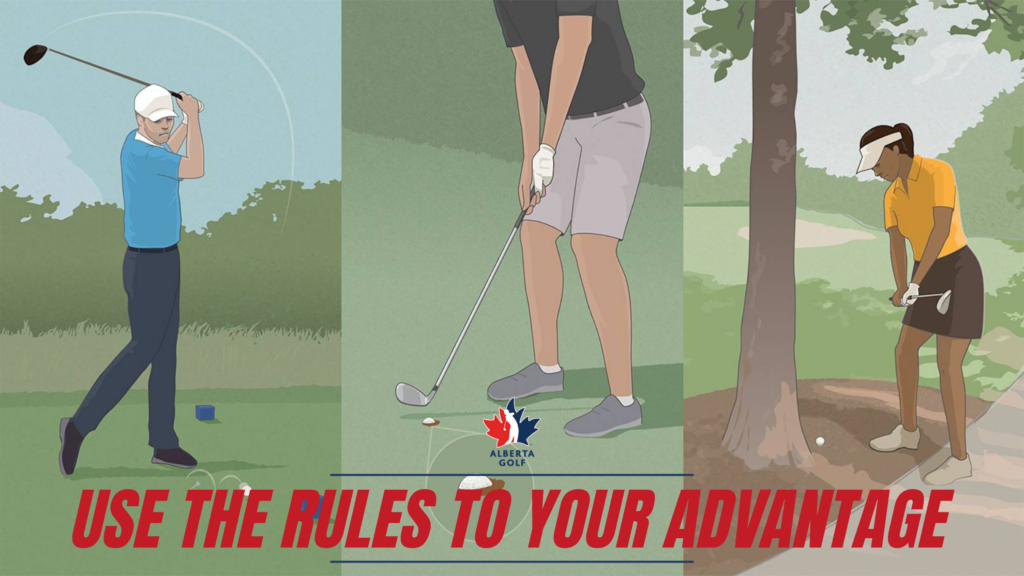
This article was originally published by the USGA.
Ask golfers how the Rules of Golf impact their round, and almost all will say that they add strokes to their score. It’s not an unreasonable perspective. We are conditioned, especially in sports, to view rules as things to avoid breaking so we won’t be assessed some sort of penalty.
An offensive lineman holding a defensive end? Ten-yard penalty. Whack a player’s arm on his way up for a layup? Two-shot foul. A catcher’s glove interferes with a batter’s swing? Automatic first base.
Yes, there are penalizing elements of the Rules of Golf, but that’s not the end of the matter. Knowing the situations where the Rules can be used to your advantage can save you from difficult predicaments, and it’s a great way to enhance your golf experience and maybe even lower your score.
Are you taking advantage of these scenarios when you tee it up?
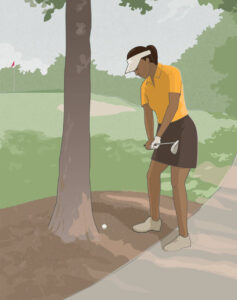
Right-handed player taking relief for playing a left-handed shot
The scenario: An errant tee shot comes to rest beside a tree that impedes your ability to take your normal swing. You decide your best option is to punch the ball back into play using a left-handed swing but in doing so, you’re now standing on the cart path.
The question: Since a left-handed swing is not your normal stance, would you be allowed to take free relief from the cart path?
The answer: Yes, because using an abnormal swing doesn’t preclude you from taking relief as long as the stroke you’re trying to make isn’t clearly unreasonable. Proceed by finding the nearest point of complete relief using a left-handed stroke. From that spot, you get a one-club-length relief area to drop the ball in.
The best part? After completing the relief procedure, you are then free to use a normal right-handed swing.
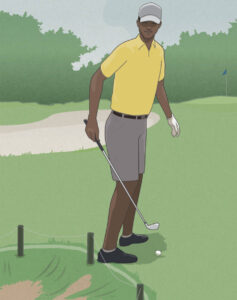
The scenario: Your golf course is working on the drainage system in the middle of a fairway. Your tee shot avoids the marked-off repair area, but your stance doesn’t.
The question: Can you take free relief when the ground under repair interferes with your stance and not your ball?
The answer: Ground under repair is treated the same as a cart path in that if you have interference with your lie, stance or swing, you can play it as it lies or take free relief by finding the nearest point of complete relief and dropping a ball within one club-length of that spot.
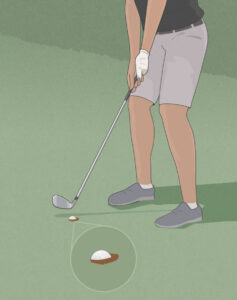
The scenario: A rainstorm left the course wet and soft. You crush your first tee shot down the middle of the fairway but when you get to your ball, you see that it’s plugged in its own pitch mark.
The question: Am I allowed to pick the ball up and take a drop for my second shot or do I have to play it as it lies?
The answer: You could play it as it lies – but why when free relief is allowed? Take your drop within one club-length of the spot right behind the ball that’s in the general area. You also have the option to clean the ball or change it out for a new ball.
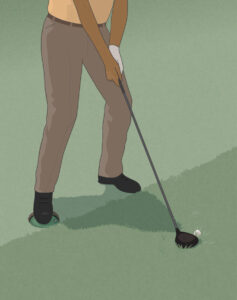
The scenario: You draw a bad lie in the rough, but a sprinkler head interferes with your stance. You wisely decide to take free relief. While your nearest point of complete relief is in the rough, you realize that your one club-length reaches the fairway.
The question: Are you allowed to take free relief from the rough and drop it in the fairway?
The answer: Absolutely! In fact, this is the exact scenario used in Clarification 16.1/1 in the Rules of Golf to illustrate that this is permissible. The rough and fairway are part of the same area of the course – the General Area – and if taking relief results in you getting better conditions, then it’s your lucky day. Feel free to drop and take your next shot.
To learn more about the Rules of Golf:
A Beginner’s Guide to Golf: The Traditions, Care for the Course, and Care For Others

Over the last six years, the game of golf has seen a major influx of attention and a steady rise in popularity worldwide. From COVID-19 and the LIV Golf drama to three seasons of everyone’s favourite golfing docuseries Full Swing, the explosion of golf social media influencers, and everything in between, the game continues to grow at an incredible pace.
In Canada alone, 2025 saw 11,276,080 scores posted in a single season—setting a new record—along with 29,383 new handicap registrations that same year. Here in Alberta, Golf Canada membership exceeded 65,000 players. With so many new golfers across the province, this guide is designed to cover the basics: caring for the course, consideration for others, and the spirit behind the game we’ve all come to love.

Golf is an individual game at its core, allowing players to play entirely alone if course availability permits. Unlike almost every other sport, golf is primarily played without the supervision of a referee. As a result, the game relies heavily on the integrity of each player to follow and apply The Rules of Golf to themselves and their playing partners.
Golf was built on sportsmanship, and players are expected to conduct themselves accordingly—showing courtesy, honesty, and respect to everyone on the course.
Consideration for Others
While golf is an individual sport, it’s played on a shared course used by hundreds of players each day. Giving others the same consideration you’d expect in return is essential.
-
Noise and Other DistractionsPlaying music, talking, etc.
Players should make every effort not to disturb others by moving, talking, or making unnecessary noise during a shot—whether it’s someone in your group or a nearby group. Music has become more common at many courses, but it’s always best to confirm with the course before teeing off and to keep volume at a respectful level.
-
Where To StandFrom green to tee
No one wants to be in the way, and the golf course is no exception. When someone is playing, avoid standing directly behind them for both respect and safety. On the putting green, don’t stand in a player’s line or cast your shadow over the hole. Putting is hard enough—let’s not make it harder for our fellow golfers.
-
Order of PlayWhat is it
In competitions, there is a defined order of play that changes based on the previous hole, and playing out of turn should be avoided. In most casual rounds, however, Ready Golf is acceptable. This allows whoever is ready first to play their shot, as long as it’s safe to do so.
-
Pace of PlayHow to avoid it
Pace of play is a hot topic across the golf industry, discussed in board meetings, locker rooms, and probably after the round as well. Keep golf fun by playing efficiently: practice ready golf, move quickly from green to tee, keep up with the group ahead, and play from skill-appropriate tees. In recreational rounds, players can use Maximum Hole Scores (Net Double Bogey) and pick up on a hole after reaching that number. Golf is meant to be enjoyable, but no one enjoys a five-hour round in the heat—so let’s keep things moving.
More On Ready Golf
Ready golf is a great way to speed up play during everyday rounds with friends. Whoever is ready to play—and it’s safe to do so—should go ahead. A few additional tips include:
- Hit before assisting in finding another player’s ball
- Shorter hitters can play first if longer hitters are still waiting
- Putt out whenever possible, including while others rake bunkers or have long walks across the green
- In competition, begin your routine while another player is preparing, provided it’s safe and not distracting
Care for the Course
Alberta is home to over 200 golf courses, all of which require care and respect so we can continue to enjoy the game. There are a few simple habits that go a long way.
-
DivotsWhat they are and how to fix
We all know the euphoria of a perfectly struck 7-iron—and the gut-wrenching feeling of a chunked shot. After either, many players walk off to their next shot, but it’s important to repair the divot (the piece of turf removed by your swing). If you’re using a power cart or pushcart, use the sand bottle provided—just make sure it’s full before teeing off. Walkers should also carry a bottle of sand. If the divot is recoverable, replace it and press it down with your foot. Then you can focus on that birdie putt—or recovering from the previous shot.
There’s a video linked at the bottom of this article to explain how to repair a divot!
-
Ball Marks On The GreenWhat they are and how to fix
TV and Instagram close-ups don’t do it justice, but few things are more frustrating than a good putt knocked off line by an unrepaired ball mark. After hitting into the green, locate your ball mark and fix it. If you have time, repair another one as well.
There’s a video linked at the bottom of this article to explain how to repair a ball mark!
-
BunkersWhat to do when you’re done
Before exiting a bunker, players must carefully smooth over any footprints, swing marks, or ball impressions left behind. That’s what the rakes are for—and we’re not in COVID anymore!
By respecting the traditions, the course, and the people around us, we help preserve the spirit of the game and ensure golf remains enjoyable for everyone.