


April 1 Registration Opens: FAQ’s and Need To Know’s
With only a month remaining before registration opens for all Alberta Golf events, here’s some important items to know ahead of time to make sure you don’t miss out this season!
Alberta Golf Championships and Qualifiers – April 1 @ 9am
Registration will open on April 1st at 9am for all events. All participants need an active Golf Canada membership with a Handicap Index. If you’re entering an event that is age based, please ensure your birthdate is listed in your account and is accurate. Players can register through the Alberta Golf website for each event or can do it directly from the Golf Canada app by clicking on the Competitions tab in the drop-down menu.
Some things to be aware for the 2026 Championship season:
- The Men’s Mid-Master Championship will now have two regional qualifiers prior to the championship. Exemptions have already been sent out for those who are exempt from last year.
- Those who qualify for a championship will have their qualifier registration fee rolled into the championship fee, leaving them with a smaller fee to play in the event. All participants at qualifiers will also get a $25 Food and Beverage Gift Card
- All participants at qualifiers will also get a $25 Food and Beverage Gift Card
Common Issues and How To Fix Them
-
Inactive Golf Canada Account
If you’re a member at a golf course or facility, reach out to them directly to get your Golf Canada account reactivated. If you’re a Public Player, you can renew your membership yourself by logging into your account.
-
Age/Date of Birth Issues
This likely means your birthdate is incorrect in your account. You can edit this in your account by logging on to your account on a computer and clicking Account Settings from the drop-down menu. You can also get your course or facility to fix this for you.
-
Handicap Index
If you have scores from last year, you can enter them into your Golf Canada account and change the date so they’re from last year. You only need 54 holes worth of scores to get a Handicap Index, and they can be any combination of 9-hole or 18-hole scores.
-
Credit Card Issues
Golf Genius uses a pending registration model, so when a player registers, they are put on this pending list. When on the pending list, multiple charges will show up but one charge is the card authorization and the other is a refund for that authorization. Your card will not be charged until you’re confirmed in the event. Once you’ve been confirmed, the charge will go through on your credit card and the other charges will be removed in 5-10 business days. You will not be charged if you’re on the waiting list!
-
Eligibility
-
Registration Error Messages
A common problem is registering on tablets or phones. The Golf Genius system works best if you register using a computer. This can explain many problems and we highly recommend registering using a computer to avoid additional pressure or issues.
McLennan Ross Alberta Junior Tour – April 1 @ 12pm
Registration for the #1 competitive onboarding junior tour in the province will open on April 1st at 12pm. Players can register as a member of Golf Canada or as a non-member. The Tour is open to all junior golfers who are younger than the age of 19 as of August 1, 2026. We have separate age divisions for U11, U13, U15, U17, and U19 on both the male and female sides.
If you’re looking for more information on the Tour, the schedule, policies and procedures, or just want to learn more click the link below.
McLennan Ross Alberta Junior tour
Common Issues and How To Fix Them
-
Age Requirements
Each age division represents the age you’re under, so U13 means you’re under the age of 13 as of August 1st. For non-members it’s very important to register for the correct age division, so if your child is turning 13 on July 31st, they should be registered in the U15 division for all tour stops. If you’re registering as a member of Golf Canada, please make sure your Date of Birth is correct in your account.
-
Email & Preferred Emails
Lots of junior’s Golf Canada accounts have email addresses that may not get checked and this can cause confusion and frustration with parents and the players. When you register, please either edit the account to have your preferred email address listed or when you register please add in your preferred or parent email address to ensure no communications are missed this summer!
-
Registering More Than One Player
If you plan to register more than one player, please use a different email or a different login for each registration. Golf Genius does not support duplicate email addresses for different registrations.
UpSwing by Alberta Golf – April 1 @ 7am
Registration for Alberta’s premier recreational events will open on April 1st at 7am. UpSwing events are open to all players, and there is no age or handicap requirements, it’s all about fun! You only need to be an UpSwing member to play. To create your account visit the UpSwing website link below.
Sign Up For An UpSwing Account
Frequently Asked Questions
-
Is this a tournament?
No, UpSwing is focused on providing fun golf experiences for the golfers who prefer a relaxing round on the links. Keeping score is not mandatory, but there may be some fun challenges that you can take part in during the round…
-
Can I book a group of two players and request to play with friends?
Yes! UpSwing is all about having fun, if you have a pairing request you would like to make, please send them to info@upswinggolf.ca after you register.
-
What do I need to register for an event?
You just need an UpSwing account, no handicap index, no Golf Canada membership, just a free UpSwing membership!
Black History Month Feature: Black Associations Helping the Community Through Golf
To mark Black History Month, we highlight several Black, Alberta-based organizations that are using golf as a platform to strengthen communities, foster inclusion, and create meaningful impact.
Golf has historically faced perceptions of exclusivity; however, the sport has evolved significantly in recent years and continues to grow as a more accessible and welcoming game. Across Alberta, organizations are demonstrating how golf can serve as a powerful vehicle for connection, philanthropy, and cultural celebration. The following examples showcase groups that are making a tangible difference through the game.
Information and images for this story were sourced exclusively from official websites and social media accounts, as we were unable to make contact with the associations at the time of writing.
Zambezi Golf
Zambezi Golf is a Calgary-based social group comprised of local businesses and individuals of African heritage. The organization is driven by a mission to bridge generational and cultural gaps among business leaders in Alberta.
Its name is inspired by the Zambezi River—the fourth-longest river in Africa—which connects Zambia, Namibia, Botswana, and Zimbabwe. As a point of convergence for these four countries, the river symbolizes unity and collaboration, reflecting the group’s goal of bringing together cultures, networks, and professional relationships.
What began as a single event has grown into a series of initiatives, including two international events scheduled for 2026. Its flagship event, the annual Zambezi Golf Tournament, remains focused on fundraising in support of African History Studies. Proceeds are directed specifically to African Studies within the Department of History at the University of Calgary, supporting Ph.D.-level research on African history topics.

African Canadian Golfers Club
The African Canadian Golfers Club (ACGC), based in Airdrie, is an association that leverages golf events to give back to the community and support those in need. The club’s vision is to cultivate a diverse community of like-minded golfers. Its mission is to use golf as a vehicle to bridge gaps, build understanding among communities, and create opportunities to give back to society.
ACGC hosts a variety of tournaments and programming throughout the season, including a one-day Battle of Alberta tournament, Single Match Play competition, Spousal Golf Training, a Ryder Cup-style tournament, and a season-long FedEx-format competition.
Its marquee event, the ACGC Open Championship, is a charity tournament that has been running for 13 years. Proceeds from the event support the Calgary Community Kitchen Program (CCKP). Since partnering with CCKP, the organization has raised more than $85,000. The Calgary Community Kitchen Program focuses on supporting marginalized Calgarians through a self-empowerment model designed to address food insecurity and related challenges.
ACGC OPEN CHAMPIONSHIP REGISTRATION PAGE

Nigerian Canadian Association of Calgary
The Nigerian Canadian Association of Calgary (NCAC) is a non-profit organization founded in 1993 with the goal of uniting, empowering, and uplifting Nigerians living in Calgary and surrounding communities.
The association offers a wide range of programs and initiatives, including cultural celebrations, youth mentorship, networking opportunities, and community service drives. Among its signature events is its annual charity golf tournament.
The tournament brings together members, sponsors, and partner organizations in support of charitable causes aligned with the association’s mission. Most recently, proceeds were directed to the African Cancer Support Group, an organization dedicated to supporting individuals navigating a cancer diagnosis.
Collectively, these organizations demonstrate how golf can extend far beyond the fairways. Through community-building, fundraising, and cultural connection, they are helping shape a more inclusive and impactful future for the game in Alberta.
What Is A Course Rating? Hear From Our Expert
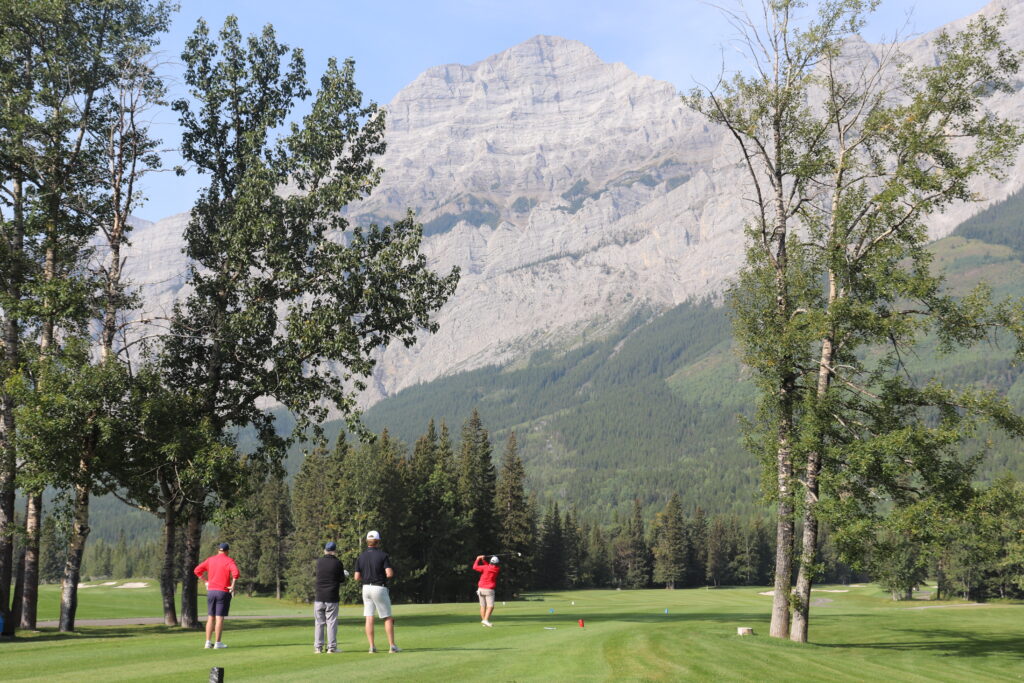
If you are a long-time golfer you may not realize how unique the sport is. It’s tough to take a step back and objectively look at the game you have adopted as part of your lifestyle. But committing 4 hours to walk around 100+ acres of land trying to put a tiny white ball in a hole while wearing a collared shirt isn’t exactly “normal”. If you have a spouse or significant other that doesn’t golf, it’s very likely they have already brought this up.
To get this objective look at golf, a good starting point is to compare it with other sports. Picture any other sport with various skill levels trying to compete in the same game. How do you make it fair? Maybe the tennis expert is forced to play with the wrong hand, the track star gives a head start, or the better hockey team needs to play with one less player on the ice. Quantifying the advantage given/taken can lead to tough situations, what if your hockey team is only half a player better? If you turn your mind back to golf, you quickly realize that the difference of skill levels is baked right into the sport.
The Handicap Index you carry as a golfer can (as of 2020) be taken around the world to compete on a fair and equitable basis with any other golfer. There are a lot of things that go on behind the scenes to make this a reality. Remember those 100+ acres of land you were wandering? They are split into 18 holes, and no 2 holes anywhere on the planet are the same. With such an overwhelming variety of golf courses, the keystone of the entire handicapping system becomes: Course Rating.
The average golfer will recognize 2 numbers when they are looking at a scorecard: the Course Rating and the Slope Rating. To reach these numbers, each hole will be measured for length, and inspected for up to 10 different obstacle factors that can impact the hole’s difficulty (water, sand, trees, green surface, etc.). Each hole will also be looked at from 4 different perspectives: a scratch male (0.0), a scratch female (0.0), a bogey male (20.0), and a bogey female (24.0). Time for our first question: Why is there a difference in Handicap Index between a male and female bogey player? Great question. There is a definite reason for this, but that won’t be the technical answer given here. The simplest answer (to almost any Course Rating question) is that although accuracy is very important, consistency is paramount. That might sound like a fancy way to say: “because that’s how it has always been”, and yes, it is. But the resistance to change from a Course Rating perspective is not for fear of change, it’s to keep things consistent. The overall goal of Course Rating is to provide a quantitative idea of how difficult a course is so it can be used to calculate a golfer’s Handicap Index. If the way we measure the difficulty of a golf course changes, all previously rated golf courses become outdated. Because a golf course is only re-rated every 10 years, that also becomes the period of adjustment for any singular change.
Once we have rated a golf course from our 4 different perspectives, we get two ratings. The “Course Rating” is the rating calculated using our scratch golfers. If a scratch golfer plays under normal course and weather conditions, this is what we have calculated they will shoot. The other rating we get is the “Bogey Rating”, or what bogey golfers would shoot under those same normal conditions. The Bogey Rating is not published as it alone does not directly impact anything for the golfer. What it does is help to determine the slope of the golf course. Simply put, the Slope Rating measures the difficulty of the course for Bogey Golfers compared to Scratch Golfers. Generally speaking, the harder a golf course, the higher a Slope Rating would be, but this is not always the case. A Slope Rating doesn’t need to be high if the course has been designed to be accommodating to the Bogey Golfer (i.e. less forced carries, wider fairways where bogey golfers would hit it, etc.). Next time you tee it up, try looking at a few holes from the 4 different perspectives. Maybe you will gain some perspective of your own on the intricacies of Course Rating.
Definitions Summarized
-
Course RatingWhat Is It
Measures the difficulty of the course for a scratch golfer (a player with a handicap of 0) under normal playing conditions.
-
Bogey RatingWhat Is It
Measures the difficulty of the course for a bogey golfer (a player with a Handicap Index of approximately 20.0 -24.0). The Bogey Rating is not commonly promoted but is essential when calculating the Slope Rating.
-
Slope RatingWhat & How To Calculate It
Compares the relative difficulty for a bogey golfer versus a scratch golfer. It is effectively the slope of the line (rise/run) between the Course & Bogey Ratings when plotted on a graph.
Course Rating is a volunteer position with many people dedicating their time and expertise to make sure Alberta golf courses are kept up to date. There is a substantial amount of communication, shared knowledge, and education between Course Raters in different cities, provinces, and even internationally. With over 35,000 golf courses across the globe, keeping things consistent is no small task!
Additional Resources
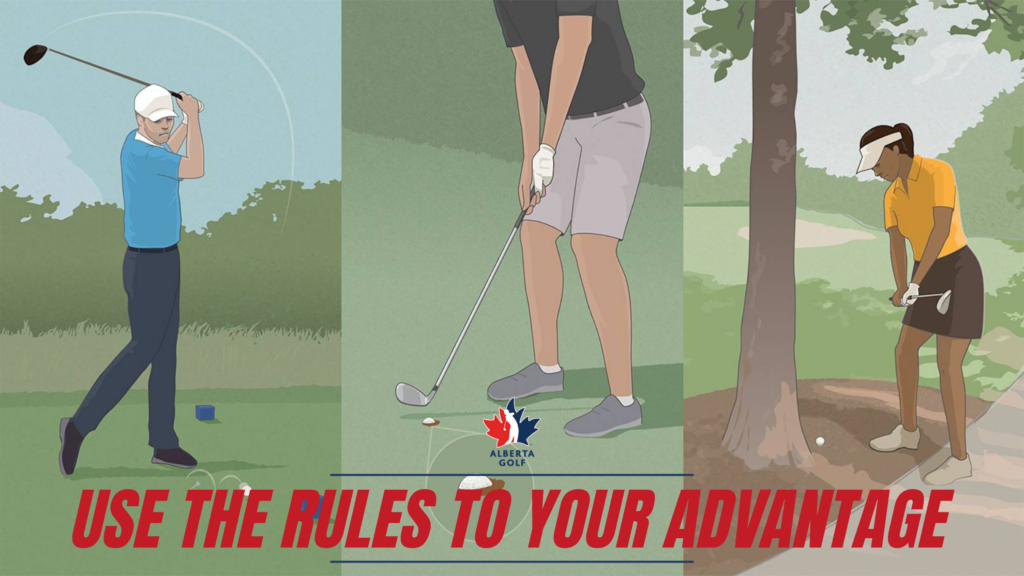
How to Best Use the Rules of Golf to your Advantage
This article was originally published by the USGA.
Ask golfers how the Rules of Golf impact their round, and almost all will say that they add strokes to their score. It’s not an unreasonable perspective. We are conditioned, especially in sports, to view rules as things to avoid breaking so we won’t be assessed some sort of penalty.
An offensive lineman holding a defensive end? Ten-yard penalty. Whack a player’s arm on his way up for a layup? Two-shot foul. A catcher’s glove interferes with a batter’s swing? Automatic first base.
Yes, there are penalizing elements of the Rules of Golf, but that’s not the end of the matter. Knowing the situations where the Rules can be used to your advantage can save you from difficult predicaments, and it’s a great way to enhance your golf experience and maybe even lower your score.
Are you taking advantage of these scenarios when you tee it up?
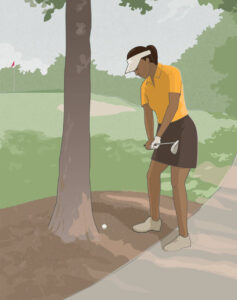
Right-handed player taking relief for playing a left-handed shot
The scenario: An errant tee shot comes to rest beside a tree that impedes your ability to take your normal swing. You decide your best option is to punch the ball back into play using a left-handed swing but in doing so, you’re now standing on the cart path.
The question: Since a left-handed swing is not your normal stance, would you be allowed to take free relief from the cart path?
The answer: Yes, because using an abnormal swing doesn’t preclude you from taking relief as long as the stroke you’re trying to make isn’t clearly unreasonable. Proceed by finding the nearest point of complete relief using a left-handed stroke. From that spot, you get a one-club-length relief area to drop the ball in.
The best part? After completing the relief procedure, you are then free to use a normal right-handed swing.

The scenario: Your golf course is working on the drainage system in the middle of a fairway. Your tee shot avoids the marked-off repair area, but your stance doesn’t.
The question: Can you take free relief when the ground under repair interferes with your stance and not your ball?
The answer: Ground under repair is treated the same as a cart path in that if you have interference with your lie, stance or swing, you can play it as it lies or take free relief by finding the nearest point of complete relief and dropping a ball within one club-length of that spot.

The scenario: A rainstorm left the course wet and soft. You crush your first tee shot down the middle of the fairway but when you get to your ball, you see that it’s plugged in its own pitch mark.
The question: Am I allowed to pick the ball up and take a drop for my second shot or do I have to play it as it lies?
The answer: You could play it as it lies – but why when free relief is allowed? Take your drop within one club-length of the spot right behind the ball that’s in the general area. You also have the option to clean the ball or change it out for a new ball.

The scenario: You draw a bad lie in the rough, but a sprinkler head interferes with your stance. You wisely decide to take free relief. While your nearest point of complete relief is in the rough, you realize that your one club-length reaches the fairway.
The question: Are you allowed to take free relief from the rough and drop it in the fairway?
The answer: Absolutely! In fact, this is the exact scenario used in Clarification 16.1/1 in the Rules of Golf to illustrate that this is permissible. The rough and fairway are part of the same area of the course – the General Area – and if taking relief results in you getting better conditions, then it’s your lucky day. Feel free to drop and take your next shot.
To learn more about the Rules of Golf:
A Beginner’s Guide to Golf: The Traditions, Care for the Course, and Care For Others

Over the last six years, the game of golf has seen a major influx of attention and a steady rise in popularity worldwide. From COVID-19 and the LIV Golf drama to three seasons of everyone’s favourite golfing docuseries Full Swing, the explosion of golf social media influencers, and everything in between, the game continues to grow at an incredible pace.
In Canada alone, 2025 saw 11,276,080 scores posted in a single season—setting a new record—along with 29,383 new handicap registrations that same year. Here in Alberta, Golf Canada membership exceeded 65,000 players. With so many new golfers across the province, this guide is designed to cover the basics: caring for the course, consideration for others, and the spirit behind the game we’ve all come to love.

Golf is an individual game at its core, allowing players to play entirely alone if course availability permits. Unlike almost every other sport, golf is primarily played without the supervision of a referee. As a result, the game relies heavily on the integrity of each player to follow and apply The Rules of Golf to themselves and their playing partners.
Golf was built on sportsmanship, and players are expected to conduct themselves accordingly—showing courtesy, honesty, and respect to everyone on the course.
Consideration for Others
While golf is an individual sport, it’s played on a shared course used by hundreds of players each day. Giving others the same consideration you’d expect in return is essential.
-
Noise and Other DistractionsPlaying music, talking, etc.
Players should make every effort not to disturb others by moving, talking, or making unnecessary noise during a shot—whether it’s someone in your group or a nearby group. Music has become more common at many courses, but it’s always best to confirm with the course before teeing off and to keep volume at a respectful level.
-
Where To StandFrom green to tee
No one wants to be in the way, and the golf course is no exception. When someone is playing, avoid standing directly behind them for both respect and safety. On the putting green, don’t stand in a player’s line or cast your shadow over the hole. Putting is hard enough—let’s not make it harder for our fellow golfers.
-
Order of PlayWhat is it
In competitions, there is a defined order of play that changes based on the previous hole, and playing out of turn should be avoided. In most casual rounds, however, Ready Golf is acceptable. This allows whoever is ready first to play their shot, as long as it’s safe to do so.
-
Pace of PlayHow to avoid it
Pace of play is a hot topic across the golf industry, discussed in board meetings, locker rooms, and probably after the round as well. Keep golf fun by playing efficiently: practice ready golf, move quickly from green to tee, keep up with the group ahead, and play from skill-appropriate tees. In recreational rounds, players can use Maximum Hole Scores (Net Double Bogey) and pick up on a hole after reaching that number. Golf is meant to be enjoyable, but no one enjoys a five-hour round in the heat—so let’s keep things moving.
More On Ready Golf
Ready golf is a great way to speed up play during everyday rounds with friends. Whoever is ready to play—and it’s safe to do so—should go ahead. A few additional tips include:
- Hit before assisting in finding another player’s ball
- Shorter hitters can play first if longer hitters are still waiting
- Putt out whenever possible, including while others rake bunkers or have long walks across the green
- In competition, begin your routine while another player is preparing, provided it’s safe and not distracting
Care for the Course
Alberta is home to over 200 golf courses, all of which require care and respect so we can continue to enjoy the game. There are a few simple habits that go a long way.
-
DivotsWhat they are and how to fix
We all know the euphoria of a perfectly struck 7-iron—and the gut-wrenching feeling of a chunked shot. After either, many players walk off to their next shot, but it’s important to repair the divot (the piece of turf removed by your swing). If you’re using a power cart or pushcart, use the sand bottle provided—just make sure it’s full before teeing off. Walkers should also carry a bottle of sand. If the divot is recoverable, replace it and press it down with your foot. Then you can focus on that birdie putt—or recovering from the previous shot.
There’s a video linked at the bottom of this article to explain how to repair a divot!
-
Ball Marks On The GreenWhat they are and how to fix
TV and Instagram close-ups don’t do it justice, but few things are more frustrating than a good putt knocked off line by an unrepaired ball mark. After hitting into the green, locate your ball mark and fix it. If you have time, repair another one as well.
There’s a video linked at the bottom of this article to explain how to repair a ball mark!
-
BunkersWhat to do when you’re done
Before exiting a bunker, players must carefully smooth over any footprints, swing marks, or ball impressions left behind. That’s what the rakes are for—and we’re not in COVID anymore!
By respecting the traditions, the course, and the people around us, we help preserve the spirit of the game and ensure golf remains enjoyable for everyone.
Helpful Resources
Long-Term Player Development Guides

One of Alberta Golf’s key objectives with the High Performance Program is to identify and support players reach their developmental and competitive goals, while providing guidance in securing a post-secondary golf scholarship. The Program aims to achieve this through supporting athletes, coaches, parents, and facilities through a tiered identification program that provides developmental training opportunities, appropriate competition, parent support, and funding for players who qualify.
As part of this objective, Alberta Golf has worked to create two important documents to help young players understand their growth within competitive golf, and help provide a roadmap for players or parents to follow when looking at performance standards and key development principles. These documents have been created using Golf Canada’s Long-Term Player Development Guide (LTPD) and has been structured to focus primarily on what Alberta’s competitive landscape has to offer. To see Golf Canada’s LTPD and all the resources available, head to the Player Development page.
Junior Golf Developmental Roadmap
The Junior Golf Developmental Roadmap helps guide young golfers in finding the right playing opportunities based on their experience and skill level, while also providing a pathway for future growth in the game. The Junior Golf Developmental Roadmap comes complete with age ranges, objectives of each stage, key concepts, and resources for parents and players to understand where they are and the next steps.
Junior Golf Developmental Roadmap
High Performance Competitive Roadmap
The High Performance Competitive Roadmap provides junior players with a guide from club-level events to competing and excelling at the national level, helping players navigate development opportunities and reach their full potential. This document has each LTPD stage referenced allowing parents or players to understand which stage they are in based on the Junior Golf Developmental Roadmap and what events they should be playing in.
High Performance Competitive Roadmap
Alberta Golf is committed to helping juniors across the province achieve their competitive goals. These documents will help provide clarity for players and parents across the province on where they are now, what they need to do to improve, and where the next opportunity for growth is.
An Inside Look At A Lesson With A PGA of Alberta Professional

What You Need To Know When Registration Opens on April 1

Alberta Golf (Calgary) – Tuesday April 1 is registration day for our 2025 Championships, McLennan Ross Alberta Junior Tour as well as our recreational UpSwing events. Here’s what you need to know to make sure it’s a smooth process to get into your events this season.
2025 CHAMPIONSHIP REGISTRATION: Registration for our 2025 Championships opens at 9am on Tuesday April 1. Make sure you have your active Golf Canada membership, a verified handicap index, and your birthdate listed. If you play in a qualifier, your fee will be applied towards the championship if you qualify for the event. 3-day events are WAGR ranked and also act as qualifiers for Golf Canada National Championships (excluding the Alberta Open). Pace of play will be a major focus once again this season at our championships. Please refer back to Golf Genius pages for updated information on each event including information for practice rounds, championship meals, quota spots, and any other item.
Alberta Golf Championship Schedule
2025 JUNIOR TOUR REGISTRATION: Registration for the McLennan Ross Alberta Junior Tour opens at Noon on Tuesday April 1 for all players who are under 19 as of August 1, 2025. Registration fees for all 25 events on the tour range from $59 to $69. New this year are 2 showcase events for parents and players who want to learn more about the McLennan Ross Alberta Junior Tour. The showcase events with a registration fee of $30 will be held June 28 at Rundle Park Golf Course in Edmonton and June 29 at Lil Devil Golf Course in Calgary and will have 9 hole play on the par 3 course with lunch, prizing and an information session.
McLennan Ross Alberta Junior Tour Schedule
2025 UPSWING REGISTRATION: Registration for our recreational UpSwing events are open at 9am on Tuesday April 1, the lone exception is our year end wrap up event at Silvertip Resort which opens on Tuesday July 1. In order to register for an event you will need an UpSwing account. To sign up for UpSwing and register for an event go to the UpSwing website. You can include a pairing request for events by emailing info@upswinggolf.ca
Hope these tips help you during registration on April 1 and we’ll see you on the fairways at our events this season.
Golf in Schools: The gift that keeps on giving

John Gordon
To find out how you can grow your business by Adopting a School, visit golfcanada.ca/adoptaschool or call 1-800-263-0009 ext. 475.
There’s been much hand-wringing recently over the “future of the game” and where golf is headed if more youngsters don’t get involved.
For those of you who really care about the future of the game, the solution might be to stop wringing your hands and use them to open your wallets. Here’s your chance.
Sept. 19-23 is national Adopt a School Week, created by Golf Canada and supported by the PGA of Canada, provincial golf associations and the National Golf Course Owners Association Canada.
Adopt a School is an offshoot of the successful Golf in Schools program created by Golf Canada in conjunction with the PGA of Canada and PHE Canada with support from the National Golf Course Owners Association Canada as a program partner. It provides courses, companies and individuals with the opportunity to “adopt” one or more schools of their choosing to introduce the Golf in Schools program at that school. (Schools can also enroll in the program on their own if they wish.)
In a very generous gesture, for a limited time the Canadian Seniors’ Golf Association is matching all adoptions, giving donors the option to select two schools to receive the GIS program, while donating funding for just one.
The GIS program, currently in more than 3,000 elementary and high schools with more than 336,000 students participating from coast to coast, includes a “best-in-class” learning resource as well as child-friendly golf-specific equipment.
“It’s a fabulous program and the equipment is so well designed,” says Enid Botchett. A retired educator in Edmonton, she has a long history in volunteerism including serving in many roles with Alberta Golf, including president. In 2012, she was named Golf Canada’s volunteer of the year.
But as excellent as the program materials and equipment are, Botchett says having a local champion for the program is equally vital.
Fellow Edmontonian Patti Christensen agrees. Now an elementary principal, she has shared her love of golf at every school where she has worked.
Like Botchett, Christensen says the Golf in Schools program is unlikely to achieve its ultimate goal of not only introducing kids to the game, but keeping them in the sport unless there is a connection with a golf course or driving range.
“For Golf in Schools to really work, you must build a community partnership with golf courses. It’s not just about showing the kids what golf is about for a day or a few days, but helping them make the connection with the real golf experience.
“Another important part of the program is to teach them not just skills but values that come along with golf, like perseverance, etiquette, sportsmanship and character.”
For golf courses participating in the Adopt a School program, there are tangible benefits. Call it “enlightened self-interest.”
“My motivation [to support GIS] is to grow the game because, otherwise, who is going to play golf?” says Jason Harris, owner of Orr Lake Golf Club near Barrie, Ont. Harris is heavily invested in the program, having adopted four schools in the area and paying a pro from a neighbouring course to visit those schools. Harris then busses the kids to his course to swing a club for real and get some pointers from a PGA of Canada member. Over the past few years, his support of the program has introduced more than 550 kids to golf.
“As great as the GIS concept is, Golf Canada can only do so much and they are doing their part by subsidizing the GIS packages and providing the grants to go into schools and to bring schools to the course,” says Harris.
“It is the ultimate responsibility for golf course owners to step up and continue or take over the school sponsorship by offering the in-school visits and bringing the classes to the golf course. We have to realize this is a top priority for the future of the game as well as for our business.”
Harris has seen ancillary benefits to his support of the Golf in Schools program.
“Sure, the kids come out to the course, but then they bring along mom and dad. Then there’s a whole family dynamic. Not only the kids want to play golf and take lessons, but so do their parents. We had 140 people go through our Learn to Golf clinics this summer. That’s 140 new golfers, so that’s a positive thing for golf.
“This entire program was great PR for us in the community plus we have definitely seen an increase in the number of juniors and families playing our course this year.”
Every journey starts with a first step, as the old saying goes.
With your support, Adopt a School just may provide that first step for thousands of youngsters to be introduced to “the game for a lifetime.”
Interested in adopting a school in your community? Check out this step-by-step infographic for adopting a school below:

Alberta Golf announces $54,000 in scholarship funds

For Immediate Release
September 9, 2016
NEWS RELEASE
Alberta Golf announces $54,000 in scholarship funds
Over 40 successful applicants were awarded scholarships for the 2016-17 academic year
CALGARY, Alta. (Alberta Golf) – Many golfers will be heading back to school with a scholarship this year, after Alberta Golf announced the 2016 scholarship recipients. The successful applicants include past Team Alberta members, past Interprovincial Team members, Alberta Junior Champions, Alberta Amateur Champions, as well as students who simply enjoy the sport. In fact, Alberta Golf’s scholarship program is open to all applicants pursuing their academic interests such that golfing ability is not a requirement. More than 20 of the recipients are past junior players who have competed in Alberta Golf’s provincial championships and several continue to play at a post-secondary level.
Scholarship applications are evaluated by a committee of volunteers based on the criteria of financial need, grade point average and volunteer experience. The funds for the scholarships are generated through a yearly casino, the generosity of patrons and from various donors and foundations.
Thanks to the following donors and foundations for their support:
Lola Rozsa, Frank Lindsay, R.E. Courage, Bob Rintoul, Jeff Llewellyn, Charles C. Reid, Christa Spahmann, McLennan Ross Junior Tour, Sun Life Financial and Alberta Golf Foundation
The 2016 scholarship recipients are:
Lindsay Almberg, Barrett Belland, Katie Benoit, Quinn Ceplis, Andrew Chelack, Celine Copeland, Courtney Dickson, Claire Emery, Jolene Freerksen, Kevin Gfrerer, Heather Gisi, Patrick Gobran, Andrew Harrison, Bria Jansen, Conaire Kehoe, Peter Keith, Kat Kennedy, Alissa Kuhn, Julie Kuhn, Brendan Kuny, Carolyn Lee, Daria Leidenius, Shaye Leidenius, Erin Martens, Kate Martens, Scott McNichol, Melanie Murchison, Brandon Murphy, Hamzah Naeem, Nathan Nobert, Jack Pengelly, Allan Pruss, Michael Pruss, Dalton Ronan, Elliot Saive, Tyler Saunders, Luke Scanlon, Amanda Sha, Tyler Vandermeer, Mackenzie Walker, Sydney Weber, Rachel Wiebe and Jack Wood.
The application process for the 2017 academic year starts January 1, with a deadline of July 15, 2017. For more information on the application process, click here.
Individual and corporate donations are greatly appreciated. Each donation is eligible to receive a tax receipt. To donate online at any time, click here.
-30-
About Alberta Golf:
The Alberta Golf Association was incorporated as a society in 1912 and continues today as a not for profit Provincial Sport Organization (PSO) operating as Alberta Golf. As the PSO, we are committed to realizing the positive impacts of golf on individuals and communities across Alberta. Our vision is that through golf, Albertans will enjoy a high quality of life, improved health and wellness, a strong sense of community, economic benefits and personal fulfillment.
For more information:
Chloe Mansfield
Manager, Member & Public Relations
Alberta Golf
(c) 587-435-6334